This documentary defies words. But that didn't stop me from writing a very long blog on this. It is a 9 hour documentary of interviews with survivors of the holocaust and witnesses to the holocaust. Anyone with an interest in WWII, the holocaust, ethnic conflict, genocide or Isreal should see this documentary. It is very well done. There are no gory photos. In fact there are by and large no historical photographs. It is all modern interviews with people who where there and who are brave enough to talk about their experience. Much of it is talking about mundane stuff and not just in the camps. There are many interviews with people in the towns who remember the deportations or who worked and lived near the camps or railroad stations. A lot of the interviews are in small Polish villages in the 1970s. That in and of itself is interesting.
As mentioned the documentary discs 1 & 2 interview many Poles. To appreciate these interviews, you should know that there is something the Poles in the interviews are leaving out. There was a lot of anti-semitism in Poland pre- and post-WWII. You only get a whiff of this at the end of disc 2 when an old woman and man start going on about Jews being responsible for Jesus' death and thus bringing blood upon their heads. It is well documented that many non-Jewish Poles helped the Germans and applauded their extermination of Jewish Poles. It is also well documented that the few Jewish Poles that managed to survive (90% of Jewish Poles were killed by the Germans) faced extreme harassment and murder at the hands of non-Jewish Poles on their return. In one of the worst cases, 80 Jewish Poles who had returned home to their small village in 1946 were rounded up and beaten to death by the non-Jewish villagers. Unlike Germany, Poland has engaged in national denial about its complicity in the extermination of Jewish Poles. Invariably when this issue is brought up, Poles make an argument about how non-Jewish Poles suffered in the war and were themselves targeted for extermination by the Germans. "How can you criticize us when we suffered so much!". You see this over and over on blogs, film reviews, & book reviews posted on-line by Poles. I can sympathize with this view since everyone knows that Hilter intended to wipe the Jews off the face of the earth (and largely succeed in Eastern Europe), but what is less well known, is that Hitlar, as part of Generalplan Ost, also planned to eliminate the Poles who were considered too anti-German to simply deport to Siberia, which was the plan for the other Slavs in Eastern Europe. Poles suffered unmitigated brutality during WWII, over 2 million civilians were killed, Poles were violently deported off their farms to make room for German settlers, and many of the war crimes/massacres at the Nuremberg trails involved actions in Poland. Nonetheless, if Germans can deal with the complicity of their grandparents and can actively try to root out the seeds of anti-semitism, why can't Poles? A recent book on what happened to Jews in Poland
after WWII is ‘Fear: Anti-Semitism in Poland After Auschwitz,’ by Jan T. Gross.
I saw Shoah foremost because of my interest in the 20th century history of Central Europe, but also because there have been profound reverberating effects of the holocaust on the current 'World Order' what with the emigration of people of Jewish descent into the US and the establishment of Israel. Of course, Europe is very different. In Central European countries, there were large economically important Jewish communities. Now they are gone -- simply vanished. But the holocaust wasn't just a tragic, horrific historical event, a chapter in the history books from which we all must learn so that "it never happens again". The world we live in today has been fundamentally changed by the events of 1938-1945, including the holocaust, and understanding the world today requires grasping the enormity of what happened then.
There are 4 discs each 2 hrs + long. The disc content is reviewed separated below.
Disc 1 contains interviews with 3-4 survivors. Two were the sole survivors from 97,000 people who were rounded up and exterminated in Poland and surrounding areas in the early part of the "final solution" when guns and gas vans were used. They survived by miraculously surviving being shot and buried in the final days of their camps. While as I mentioned there is nothing in itself visually disturbing and much the dialogue is quite mundane, there were a few very difficult sections. It was very hard to listen to one man talk about having to dig his family out of one of the mass graves and burn them, and about how he begged to be shot but they refused since he could still work. Another difficult part was the interview with one man who talked about what it was like for people (Jewish) who were transported in from outside of Poland and who had no idea what was going to happen. He was one of the 100 men that would be selected from each train load unloaded in Treblinka. These men were to immediately sort and clean the clothes that were shed when the rest, thousands, undressed and were moved to another area sight unseen. He describes working furiously while surrepticiously trying find out what would happen to his family by asking one of the older crew leaders (another prisoner) directing the new guys. His description is chilling: "The man hissed 'they've been killed'. I whispered 'That's not possible! They were here 15min ago.' At that moment, we were in complete shock. You could see the information spreading among the men -- that their wives, their children, their parents, their brothers and sisters who were there just a moment ago...were dead. That night in the barracks -- each man lay in shock unable to sleep, just staring. In the morning, 4 or 5 men had managed to take their lives. The shock is more than you can imagine." So yes, there are parts that are hard to hear.
Disc 2 also concentrates on the same era -- the early part in 1939-1941 when 97,000 Jews were killed with guns and 3 gas vans (moving vans where the exhaust was diverted into the compartment where people were packed). Disc 2 focuses more on interviews with Poles who were in the area -- living near the building where the people were gathered, working in the forests or nearby fields, or simply living next to the Jewish quarters. It also has interviews with some Germans who worked in the camp and with the wife of the Nazi school teacher who was one of the German settlers sent to Poland. This woman was particularly interesting to me -- she had clearly come to some acceptance of having been there and known what was happening. You just didn't look and didn't want to know simply because you didn't dare. But everyone there knew.
That the Western world stood by, proverbially holding their hands over their ears and shouting "I don't want to know", while millions were systematically exterminated is something that I found myself continually returning to while watching Shoah. I don't feel any moral superiority to the Western citizenry of 1938, rather I am struck how, as individuals, we have such a strong inclination to bury our heads in the sand and secondly I feel dismayed by the inability of citizens to stop a government's slide to militarism and evil.
Disc 3 & 4 notes to come.
Viewed on DVD from Netflix.
Labels: Germany, holocaust, Poland, WWII
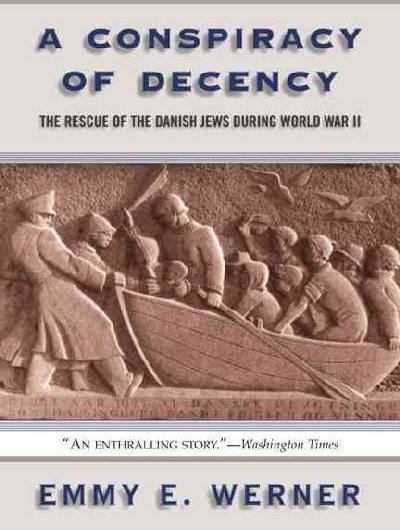 I picked this up from the library while searching for "A Woman in Berlin" or other searing personal narratives from fall of Germany in WWII. I thought I'd read an uplifting story about WWII for a change. This one tells the story of the rescue of 90% of Denmark's Jews (some 8,000 people) in 1943. It is an amazing story of one act of conscience after another.

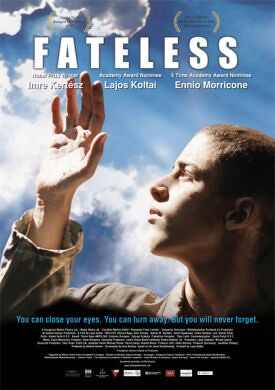 Movies about the holocaust always make one hesitate. "Am I really in the mood for this?" is the invariable question. Fateless is a movie set during the holocaust – although it is not *about* the holocaust. Rather it is a movie about the most profound experience of the script writer's life, which was the year he spent in a concentration camp in Poland. The film is not making a statement. It is not trying to 'make you understand'. Rather it is an honest and personal story about what it meant to him to go through this experience. In this, it challenges our definition of the horror of the holocaust, because that definition must somehow come to grips with… happiness. For the writer, happiness was the one free hour they had each day between end of work and lock-down in the barracks – an hour that just so happened coincided with dinner. This hour was raw happiness. In that moment, it seemed he was to say, you are not thinking about the bigger picture that your happiness is an artificial result of the fact that you are being worked and starved to death. You are concerned with the here and the now, with your small spot of reality, and in that moment, he experienced the intense happiness of a moment of free time combined with the anticipation of food. Also the film shows the profound bonding that occurred between the prisoners. Again it occurs when they are faced with inhumanity, for example being forced to stand all day and night, but nonetheless regardless of the reason, the reality is that intense bonding occurs. Also he experienced true friendship and kindness in the camps – from fellow prisoners in the camp who reached out to help him. In some ways the film reminded me of the feelings that war veterans try to convey – the conflicting feeling that their experience was hell but at the same time was the most profound and bonding experience of their life.
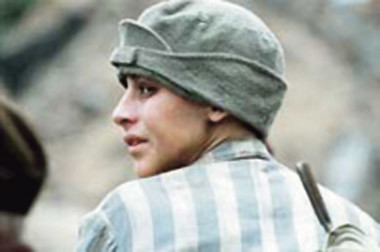 Fateless is a beautiful and honest movie that I strongly recommend to anyone who has the film “Schindler’s List” on their personal top 100 film list. The writer is highly critical of Schindler’s List, which he views as not an honest portrayal of the experience, but rather a Hollywoodification of the experience and a film that makes us view the people sent to the camps as caricatures rather than people just like anyone else. Nonetheless I think that if you didn’t like Schindler’s List or intend never to see it, then Fateless probably isn’t for you either. Personally, I think Fateless is quite a bit better than Schindler’s List, and it surprises me that it did not get a bigger indie theatre showing in Seattle.
