Wednesday, May 19, 2010

The Masaryk Case: the Murder of Democracy in Czechoslovakia * * * *
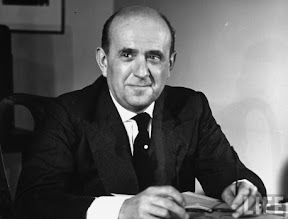
Jan Masaryk in exile Jan 1 1938World War II altered forever Americans "world-view" and how we view international conflicts and war. Though easily forgotten, Americans themselves were of an "isolationist" view before WWII. A poll in Dec. 25, 1938 found Americans 6 to 1 against sending troops to Europe; "It's not our business!" was the universal view. Munich 1938 was the beginning of a change[2] -- because it was such a terrible betrayal and because of Jan Masaryk's eloquent writings and speeches on his country's plight. Today few outside the Czech Republic and Slovakia would recognize the name of Jan Masaryk, but in 1938 and during WWII, he was a well-known diplomat and radio voice in America and Britain. A BBC radio address by Jan Masaryk on August 27, 1939 as Germany threatens to invade Poland:

Czech Ambassador In London On Poland Situation – 1939-08-27 BBC


After WWII, Jan Masaryk returned to Czechoslovakia to help save democracy in his country and prevent takeover by the communist party and imposition of a totalitarian government. On March 10, 1948, Jan Masaryk was murdered[1] and the communist party took over the government.

Written by an American journalist, this book tells the story of the events of those tumultuous years and the events and people surrounding his death. The interviews and research for the book took place during the summer and autumn of 1968 -- a rare window during which a Western journalist could travel and talk with people in Czechoslovakia. During the 1950s, the Iron Curtain was an Iron Wall for people outside the communist bloc. Travel into the communist bloc from the West was difficult and once inside, speaking with people was next to impossible because the consequences for speaking with a Westerner were harsh. No one spoke freely except to their closest and most trusted friends. It was a cold gray never ending winter. But then in the summer of 1968, a miraculous thawing, the Prague Spring, occurred in Czechoslovakia. Restrictions on speech were lifted and for a brief few months the Czechoslovaks were free to speak out. During that summer of 1968, an American journalist went to Czechoslovakia to investigate one of this great intrigues of end of World War II, the death of Jan Masaryk. Her book, "The Masaryk Case", is about what she discovered during her investigations and interviews, but much more than that, it is a rare glimpse into the communist bloc during the middle of the Cold War.

The central character, Jan Masaryk was the son of Tomas Masaryk. Tomas Masaryk founded the Czechoslovak democracy after WWI and was the first Czechoslovak president. At the time, that is during WWI in the 1920s, Czechoslovakia was in some ways the adopted child of the United States. The U.S. was instrumental in helping guide Czechoslovakia to democracy after WWI, and the first Czechoslovak constitution was signed in New York City. The Masaryk family had a number of connections to America including close relatives there. During the 1940s, the time during which much of the story in this takes place, Tomas Masaryk was already revered as a great statesman and leader. To the Czechoslovaks, he was (and still is) revered like George Washington or Abraham Lincoln are revered in the U.S.

His son, Jan, however was an incorrigible playboy with seemingly none of the talents of his great father. In Jan's late teens, he was sent by his family to America to make his own way in life -- and presumably teach him a few lessons. Jan lived 10 years in America, working in menial clerk jobs. In his late 20s, Jan returned home and was promptly drafted into WWI and served in Austria. After the war, Jan continued his playboy ways but began to assume some of the responsibilities foisted upon him by his lineage as the son of a national hero. He took a position as a diplomat in the government of Benes, the 2nd Czechoslovak president. Jan perhaps would have remained just the playboy son of Tomas Masaryk in the Czechoslovak national memory if it were not for Munich 1938 and its aftermath. As it was, he became the embodiment of the tragedy of Czechoslovakia in WWII, and his death/murder became an allegory for the murder and betrayal of Czechoslovakia.

Munich 1938. In one of the 20th century's great betrayals, William Chamberlain -- the prime minister of Britain at the time -- sacrificed Britain's ally, Czechoslovakia, to Hitler in an attempt to appease Hitler and preserve peace. Czechoslovakia's defenses along her western border were handed over to Germany and the Czechoslovaks were ordered not to resist. Once it became clear that Czechoslovakia's allies (those with whom she had mutual military assistance treaties), England, France and Russia, would not come to her aid, she was quickly dismembered by her neighbors. Four months after Munich, she was an occupied country. Her resources were sent to Germany, her industry was serving Germany, and her population was enslaved to serve the Reich. One of the most industrialized countries before the war, she would go on to become the arms factory for Germany during the war.

Jan Masaryk's was serving as a diplomat in London at the time, and he became the voice of Czechoslovakia's tragedy. He spoke English fluently and without accent, and gave many radio speeches during that time. From one of his radio addresses after Munich:


Text of the radio address in the video above: “You will see things happening in my little country diametrically opposed to everything my father stood for and I humbly but proudly stand for today. And I beg of you to understand it. My people were terribly hurt. They were suddenly told, with very little ceremony, that they must shut up and give up. Otherwise – it was a terrible otherwise… This is another job for the historians. I am not really complaining. I am just trying to explain in simple words what went on in the heart of the simple Czech and Slovak, man and woman, who trusted their allies and their friends and quite suddenly found themselves alone, bereft and destitute in a blizzard of harshness.”

This book was fascinating to me because it told about the life of Jan Masaryk and the crucial pre- and post-WWII years involving Czechoslovakia. But it also tells a fascinating story about the Czechoslovak mindset in the late 1960s and about how people processed the war and the post-war betrayals and upheavals. The thing that comes up repeatedly is how Czechoslovaks who lived through the war and post-war period were trying deal with their own feelings of complicity in their downfall. The people she interviews have a sense that the Czechoslovaks did not really resist the Germans. In the sense that there was no great partisan movement as in some other Slavic countries, e.g. Poland and Belarus. This is not to say there weren't partisans and that there are not examples of courageous resistance, but the Czechs feel that they tended to take the easier (and less lethal) ways out. Upon invasion, the government quickly aligned with Germany--true the alternative was terrible. Later it aligned with Russia--again the alternative was terrible.

But they Czechs she interviews express a lurking sense that their country and they themselves were always making a Faustian bargain with some devil or another. On the other hand, the Czech Republic was the only German-annexed country that did not provide troops for the Reich Army. Every other annexed country did: Romania, Slovakia, Hungary, Austria and Poland. The Czechoslovaks that the journalists interviews bring this up themselves and are obviously trying to process all these conflicting views of themselves. They seem large unsuccessful in this attempt.

--EEH, May 19, 2010

________________________________________________
Radio Prague article about the 60th anniversary
http://www.radio.cz/en/article/101758

Radio broadcasts
http://www.radio.cz/en/article/11875

http://archiv.radio.cz/english/talking/16-11-99.html

[1] Change in the official verdict: murder
http://www.radio.cz/en/article/49113

[2] A sea change in public opinion about strict neutrality (including no arms shipments to England) occurred after the Munich agreement. This change in public opinion is reviewed from the perspective of late 1939 in the article:
Influences of World Events on U.S. "Neutrality" Opinion, Philip E. Jacob, The Public Opinion Quarterly, Vol. 4, No. 1 (Mar., 1940), pp. 48-65. In a short period of 8 weeks public opinion switched from high levels of support for complete neutrality to the opinion that the US should support England and ship weapons to England and France to resist Germany. This change in public opinion did not however extend to sending troops. Resistance to sending troops remained very high--ca. 95% against and ca 80% against EVEN if England and France looked like they would lose. After Munich, this erodes a bit to 84% and 54% (if E and F are losing). But by the end of 1939, opinion switched back to extremely high resistance to sending troops (unless the US is attacked). However, the change in public opinion concerning arm shipments to England did have an effect. The arms embargo that prevented weapons from being sold to England was lifted on November 4, 1939 (via modification of the Neutrality Act). For reference, Germany invaded Poland on Sept 1, 1939 and England declared war on Germany on Sept 3, 1939.

Labels:

Tuesday, April 22, 2008

Pupendo * * *

image from from Pupendo, Czech film Pupendo (link to DVD on Amazon)
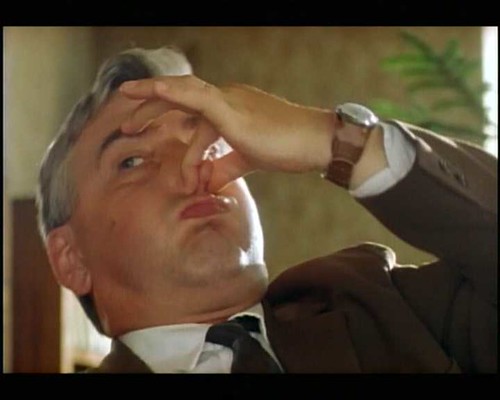
"One day a little tapeworm poked her head out of an anus, looked around at the big wide world. She popped back in and raced to find her mother. 'Oh, mommy tapeworm what is that great and lovely blueness that is all around outside?' 'That my darling is the sky.' 'Oh mommy tapeworm, what is that beautiful yellow orb in the sky?' 'That my darling is the sun.' 'But why mommy, why do we live here, here in the dark?' 'Oh my darling, because this, this is our HOME...yes, my darling, up someone's ass.' -- a joke told by an insurance appraiser from the movie Pupendo.

image from from Pupendo, Czech film
This movie is a comedy-drama about the 1980s in Czechoslovakia, and that little joke sums up the Czech perspective pretty well. Yes, we're living in crap, but nonetheless it's home. The story follows a talented Prague artist, Bedrich Mara, who in the heady years around the 1968 Prague Spring was one of the top artists in the country with his work shown in the west. But he refused to make the necessary compromises (join the communist party presumably) and has fallen out of favor with the authorities. He loses his job, is ostracized from the art community, and barely brings home enough for his family by making kitschy clay things, like a money bank that looks like a butt. The movie tells the story of a summer in which on a bit of a lark, he brings home a bum. The bum turns out to be an art historian caught at a particularly low point. And through a bitter-sweet series of events, he helps Bedrich return to the international art world -- although at costs that have a certain black humor to them.

Pupendo is by the same director that made Pelisky, and it feels like a follow-up. Pelisky was a comedic-drama about life in the summer of 1968, while Pupendo is a drama-comedy about life in the 80s. But I think one reason Pelisky was more successful was that Pelisky combined funny with a very obvious tragedy -- the 1968 invasion. In Pupendo, the juxtaposition of funny and serious is not as effective -- perhaps because the tragedy of the 1970s and 1980s, the post-1968 period of "Normalization", is difficult to capture on film unlike tanks rolling down streets. "Normalization" is an Orwellian term because it refers to squelching the "abnormal" ideas of freedom of speech and civil liberty that dominated the the attempt at humanizing Czech communism (Jan-Aug 1968). I once heard a Czech describe the difference between the Stalinist oppression in the 1950s versus the Normalization oppression in the 1970s. In the 1950s, you were executed but there was a certain logic and predictability to what activities would get you killed. In the 1970s, you were ostracized rather than executed, but punishment was completely capricious. You think you are fine, and then some innocuous comment, or forgetting to put up a flag, gets you on the blacklist.

For this reason, I think the film probably has mainly home-market appeal, unlike Pelisky which is likely to be quite funny and tragic to non-Czechs also. Also Pelisky has Miroslav Donutil, one of the most famous Czech comedic actors, who is hilarious in the movie.

image from from Pupendo, Czech film Pupendo refers to a Czech "game" in which a heavy coin -- in this case a 5kc piece which is about like a Sacajawea or Loonie -- is thrown swiftly down onto the bare belly of the "recipient". If done correctly, the coin lands flat and gives a frightful sting. Video of pupendo being played. Why this movie-vignette about life in the 1980s in Czechoslovakia is named after this slightly sadomasochist game is unclear. Presumably it is meant as some kind of metaphor, but I couldn't quite get it.


I purchased the DVD in the Czech Republic where it is widely available in video stores. Purchasing or renting it outside of CZ is difficult, but in the U.S. you can try searching on www.eBay.com; you'll sometimes find it for sale there.

Labels: ,

Thursday, February 07, 2008

The Greatest Czech: Jara Cimrman

Commentary by Kaja

In the heat of an early and humid summer, I had my first encounter with the famed Jara Cimrman, the Czech Genius. I’d heard the tales and only seen the dents in the sofa left by Cimrman’s fame before, but last night I went to a production of one of his plays, AKT.

I emerged from the show, but this elusive Bigfoot of great minds remained as ephemeral as before. The reason? The persona of Cimrman is a creation of the great Czech actors Zdeněk Svěrák and Ladislav Smoljak. They created the character during an era of satirical self-reflection and the transitional post-WWII era. While originally intended as a caricature of Czech people, history, and culture, he became and remains an immensely popular national hero. This is most evident when considers that Jara Cimrman would have won the Czech Television contest to choose THE GREATEST CZECH. Including candidates from pop-singers, kings, and other national heroes, Cimrman was disqualified from the competition only because he never truly existed. The prize went to the runner up, King Charles IV, founder of the Charles University and Charles Bridge in Prague during the 1300s.

The story goes that Cimrman was ridiculed and eschewed throughout his life. Thus, he passed into and out of this life understated and with only a bang or two. However, as with many great geniuses, Cimrman rose to glory only after his death when, in 1966, Dr. Evzen Hedvabny (Dr. Silky) discovered a locked chest containing many of Cimrman’s works. The brilliance of these works were instantly recognizable—needing little more than a glance at a title—and Cimrman became recognized as one of the world’s most accomplished men (certainly the greatest for the Czechs) as a poet, a composer, playwright, not to mention a philosopher and inventor.

In order to further expound and present Cimrman’s greatness to society, a panel of experts (in each field) was assembled to lecture on these accomplishments. Thus, the composition of the performance was as follows: lecture, intermission, and performance. Most likely needless to say, the panel of experts was composed of the actors. This first section was perhaps the most interesting and entertaining. Playing on inter-discipline tensions and differences, the academic territoriality became increasingly evident with each presentation. Of course, each performance was replete with stereotypes; most notably, the spacey engineer.

The second half was a performance of one of Cimrman’s discovered plays—contextualized, of course, by the preceding lecture. AKT, as the play is named, presents an elderly couple in a painter’s loft atelier. In one corner is a covered painting. The couple is anxious. Mind you, this is a seasoned and well-respected, all-male ensemble. From here on out, imagine all events saturated with cross-gender humor.

Much waiting and three guests later, the plot thickens. The first guest is a teacher with a touch of pedophilia. The second, a fat realtor. And the last, a sex-crazed psychoanalytic. Each believes that their invitation is related to their field and that they have arrived at this mysterious place, on some mysterious day, at some mysterious time to make a little extra money under the table.

The rest of the play revolves around an uncompleted painting of a nude woman: the elderly wife as a young woman. The elderly artist states, that each time he set out to finish the painting he was seized by a fit of passion and that one of the three guests was the result of these “artistic” sessions. And there we have it! The plot: gentleman, I am your father. She is your mother.

I am not averse to sexual insinuation and lowbrow humor. However, when juxtaposing the two halves, I find the turn of phrase and intellectual foray more interesting than the latter. An example of the intellectual texture is the layers of meaning captured by the name "Cimrman". The name conveys a duality of heritage that is representative of the Czech nation. Jara Cimrman was the son of an Austrian mother, Marlen Jelinek (a Czech name meaning young stag) and a Czech father, Leopold Zimmerman (a German name meaning carpenter). The name “Cimrman” is the Czech phonetic version of his father's German name. While considering himself Czech and associating most with his Czech heritage, he is so confused by his ancestry and education that he speaks German with Czech-isms and Czech with German-isms, supported by a fair number of quotations on a number of topics. This linguistic word play persists throughout, even in the text of AKT itself. This first part, I believe, most fully engenders Czech people, history, and zeitgeist.

The most striking part of the performance was realizing a connection between Cimrman and another Czech folk hero: the good soldier Svejk. Both characters are created personas supposedly representative of the Czech nation. Yet, Svejk and Cimrman are antithetical. One is the greatest Czech in accomplishment and societal contribution. The other is a bumbling good-natured fool who, despite his repeated screw-ups, always manages to survive and escape harsh consequences. Cimrman’s success is his active and intellectual engagement with the world and its events. Svejk’s success stems from his complete disengagement from anything beyond his immediate surroundings. I have puzzled over this ostensible contradiction since the performance. I have yet to reconcile how both can stand shoulder-to-shoulder, filling the same role in modern Czech folklore.

I recommend that everyone read Jaroslav Hasek’s The Good Soldier Svejk. I would also recommend that you visit the Theater of Jara Cimrman, but unfortunately this is limited to those who understand Czech (or Slovak).

Labels: ,

Sunday, November 12, 2006

The 1940 and 1950s in Central Europe: Film

The 1940s and 1950s in Central Europe (Germany, Hungary, Czechoslovakia, Poland) is a historically fascinating and tragic period marked by devastating war and totalitarianism. Below is an annotated list of films reviewed in SunnysideKitchen that are focused on this period. Some of these films were made behind the Iron Curtain. There are a couple dates to keep in mind for these. Stalin died in 1953 after which there was a loosening of the restrictions on the kinds of films that could be made and filmmakers were no longer in the "socialist realism" straight-jacket. So these films span two different eras: before- and after- Stalin's death. The Hungarian films have another important date: 1956, the year of the Hungarian Uprising, after which hard Stalinism returns to Hungary. For the other Warsaw pact countries, 1968 is the more critical year. This is the year of the Prague Spring. After that is crushed, severe film censorship returns for all filmmakers behind the Iron Curtain and things don't get better until the late 1980s when the communist governments are overthrown. Burnt by the Sun (1994) This film is set in the early 1930s, so a bit before the 1940s and it's set in Russia, which is not Central Europe. Nonetheless, it is about an important aspect of the tyranny of communism and Stalinism, in particular, that affected Central Europe in the 40s and 50s -- which was the capacity of the system to turn on it's own followers and use this unexpected violence to control. Directed by Nikita Mikhalkov, one of the most famous modern Russian directors. Ballad of a Solider (1959) Most Americans have no idea of the suffering and sacrifice Russians experienced in the war. This film gives you an air-brushed taste of that. It is a famous Russian film about a young soldier who travels home to help his mother in the midst of the war. Before 1953, all WWII films in Russia had to follow a "great Red soldier" script. After 1953, there are a series of films about the terrible human toll of WWII. This is one of the most famous of those. Downfall (2004) Excellent film on the last few days of Hilter's life when he is in the bunker. Shows the downfall of Berlin. HIGHLY RECOMMENDED. The Bridge (1959) An anti-war film made in the late 1950s in West Germany. Shows the home front situation and mentality as the Americans are pressing across Germany. Eroica (1957)Two Polish films on "passive heroism". The first is about a man who is not at all interested in dying for his country, but ends up helping the partisans against the Germans none the less. The second is about a group of Polish POWs who are descending to madness and one who makes an unusual sacrifice to help the group morale. Fateless (2005) Autobiographical film about the experiences of a 14-year old Hungarian Jewish boy who is rounded up and sent to the camps in Poland. Beautiful film. Heimat Heimat episodes 1-7 follow a German family in a small German village through the end of WWI to the end of WWII. We see from their perspective the radical changes that happened: poverty and hardship after the end of WWI, followed by great infrastructure improvement (roads, electricity) and an increase in personal wealth, the rise of the Nazis and war, and then defeat and occupation by the Americans. I found it a bit slow, frankly. Ivan's Childhood (1962) Beautiful yet searing indictment of the brutality of WWII. It follows a 10-year old boy, Ivan, who becomes a scout for the army. Judgment at Nuremberg (1962) Excellent film that explores the culpability of German judges within the corrupt Nazi State and the manner in which people can become morally corrupt even though at each step they take what they believe is the most morally defensible position at the time. LoveFilm (1970) This film is set in the 1960s in Hungary, but it has many flashbacks to WWII and the immediate post-war period in Budapest. By Hungarian director Istvan Szabo. Mein Krieg A German documentary (in German with subtitles) using footage taken by soldiers fighting on the Eastern Front. Even if you can't understand German it is interesting because it shows really what it was like from the heady days at the beginning of the invasion as they moved at full speed to their depressing retreat back to Germany after brutal casualties. HIGHLY RECOMMENDED. Mephisto (1981) This movie is set in the late 1930s in Germany. Explores the role of artists (and by extension intellectuals) within a totalitarian state. It is a clear metaphor to the moral dilemmas faced by artists, such as the director, working behind the Iron Curtain. The Murderers are Among Us (1945) This movies is set immediately after the war in Berlin. It is one of the most famous of the "Rubble Films". This film show you what Berlin looked like right after the war. Unfathomable. DEFA's first film -- the state film monopoly that started in the Soviet zone of Berlin and then became the GDR film monopoly. NAPOLA (2004) German movie about a young poor man who goes (against his father's wishes) to a National Political Academy (NAPOLA), which were military schools run by the Nazis. The movie is kind of like "Dead Poet's Society" but at a Nazi military academy. Shoah (1985) An impressive 8-hr documentary which interviews people who were in Poland and witnessed aspects of the Holocaust. It includes both people who survived the camps and people who saw the trains or saw the camps from the outside. This is a must see for anyone interested in the history of this period. Sophie Scholl: The Final Days This is a film about one of the few resistance groups in Germany during the war. They were a group of Munich students who distributed fliers protesting the war. After Stalingrad, they produced a flier telling people about the huge casualties and arguing for armistace. They were caught and executed. The film focuses mainly on the trials and the resolve of the students to die for their beliefs. This movie illustrates one reason that there was not much resistance -- an effective police state combined with swift execution for those who dared to question the war. Stalingrad (1993) This German movie covers the bloodiest battle in human history where 1.25 million soldiers were killed and another 1/2 million civilians perished. HIGHLY RECOMMENDED. Zelery (2003) A romantic epic set in 1945 in Czechoslovakia. A beautiful Czech film that is mostly about village life, but it also illustrates the mass rape and pillaging that Russian soldiers committed as they swept across Central Europe.

Labels: , , , ,

Saturday, April 08, 2006

Ucho (The Ear) * * *

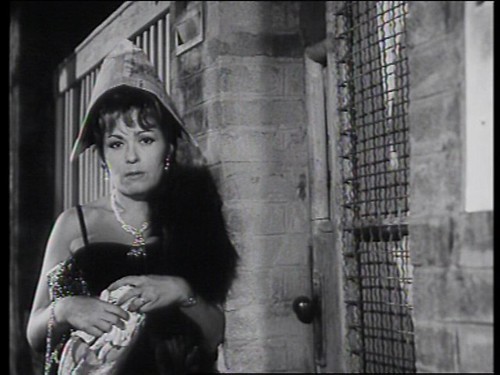
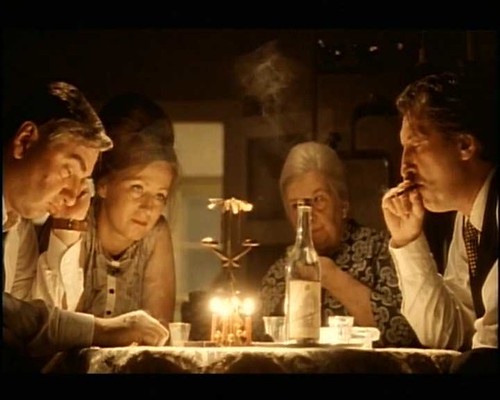
1970, Czechoslovakia. A man and his wife are returning home after a late party. They discover that neither has the house keys. They argue. He finally climbs over the garden wall and breaks into the house. What begins as an irritating hassle, evolves into a story of suspicion and panic when they realize that someone has been in the house. Flashbacks to the social gathering earlier that evening piece together the reason for the panic. The man is a high level member of the Communist party. His boss, a minister, had been arrested that very evening by the secret police; a victim of the 'shoot the messenger' reaction when he turned in his report on brickyard closures. As for the couple, while the panic sets in, a picture emerges of a family living precariously in the peak of communist luxury(*) but in an atmosphere of fear within a political world that capriciously promotes people, or strikes them down at will. They assume as a given that their house is bugged and refer often to "The Ear" -- they argue in the bathroom where they can turn on the water and make love on the floor in the kitchen which they calculate is less likely to be bugged than their bedroom. The movie is the story of one psychologically harrowing night, combined with flashbacks to key conversations at the earlier social gathering, as the man tries to sort out what's happening and whether he to is to be picked up and dragged away. Random memories of remarks and incidents become full of meaning and foreboding. Claustrophobic uncertainty builds throughout the movie, and film eventually culminates in an unexpected twist.
Behind the Iron Curtain during the Cold War years, moviemaking like all of media was heavily censored by The State. Thus there are few films about the realities of life in the Soviet-controlled socialist countries -- for the obvious reason that within the Eastern bloc, such films could not be made, and outside the Eastern bloc, such topics would not be marketable. But during the 1960s in Czechoslovakia, the director/writer team of Karel Kachyna/Jan Prochazka started making films that pushed the boundaries of what was allowable. They made films that were pessimistic when films had to be optimistic by strict party demands. They followed characters that were not supposed to even exist in socialist Czechoslovakia, such as prostitutes and alcoholics. They told stories involving the dark side of agricultural collectivism and even of WWII partisans. Many of their films were banned upon release. But the miraculous fact that these films were allowed to be completed at all was not so much the result of the easing of the political climate in the mid-1960s, but rather of the fact that ironically Jan Prochazka was an influential member of the Central Committee of the Communist Party. He even became a confidante of sorts for the back-then Czechoslovak president Antonin Novotny, in the latter's difficult relations with the rising guild of Czech writers and filmmakers. During the last of 1960s, many reformers like Prochazka had moved upwards in the levels of Czechoslovak society, within and without the Communist Party, and it even seems that the 1968 reform era of Prague Sprign owes in part its existence to Jan Prochazka.

In Ucho, Kachyna/Prochazka point the lens straight at the Communist Party and its leaders. Party members are generally scheming ambitious bullies and the few true idealists who spout about 'socialist principles' seem to be bitter caricatures. The president of the country and the head of its Communist Party is a scary combination of power and stupidity. At one point he says, "Sometimes I even think to myself: 'I don't know anything about any of this.' But then I think: 'I need to make a decision; we can not defeat imperialism by being indecisive.' So I make the decision. And you know, I then tell myself: 'You made a good decision!'" The audience nods and smiles vigorously, 'Comrade is such a good leader!'. Indeed, this film is so scathing towards the Communist Party that it seems unlikely it would have been allowed even in the thawing climate of early 1968.

But this movie was not made in 1968. It was made in 1969/1970 after the Prague Spring was crushed by the "Armies of the Brotherly Nations" (the Warsaw Pact) to protect Czech socialism from counter-revolution. In the aftermath, the Communist Party was purged of reformers -- such as Prochazka. This film is the story of one night during which one of these reform-minded ministers (the man's boss) is purged. "The Ear" was immediately banned on it's release, and Jan Prochazka was banned from further work and died a year later. After his death, use of his unfilmed screenplays was forbidden. "The Ear" was released 20 years later in 1989, after the Velvet Revolution overthrew communism in Czechoslovakia. It stands as a true insider's view of the Community Party behind the Iron Curtain and the associated 'priviledged' life of those as the top of it.

(*) Life for regular people (meaning not in the communist elite) was very spartan behind the Iron Curtain. The shelves in grocery stores were invariably bare. To Western eyes, the life of this couple will appear average middle class. But to Czechoslovaks in 1970, the luxuries that are seen in the film -- roast beef, commercial liquers rather than the homegrown slivovice -- would have been unheard of and not to mention galling.

Rented from Scarecrow Video.
My epinions review of Ucho.

Labels: , ,

Thursday, December 01, 2005

Pelisky * * * *

The year the Comrade Armies saved the Czechs from their Prague Spring

Pelisky (link to DVD on Amazon)
Pelisky is a popular recent comedy from the Czech Republic set in the Communist period. It follows three families in Czechoslovakia over the Christmas holidays 1967/1968 and then the day of August 21, 1968. It has some universal themes: teenage angst or "Help me I've been abducted into the most embarrassing family on earth", the comical joys of dating after 40, and the universal humor of the holiday family gathering. This is a very funny movie that really captures Czech culture and personality -- although non-Czechs will recognize many of these characters from their own extended family. But to understand the movie, you need to have a feeling for the special 1967/1968 years in Czechoslovakia that these characters were living through.


Post WW2, the liberation of Czechoslovakia from the Nazis by The Red Army led to an immediate strengthening of the political power of the local Communist Party, and in February 1948, sensing loss of popular support right before the upcoming elections, the Communist Party of Czechoslovakia staged a political putsch in which the country became a hard-core Stalinist state. A bloody period of 1950's ensued: purges, executions, uranium mines, labor camps, collectivization of the farms, confiscation of property, fall of currency and confiscations of life savings. For many young people, however, it was also a period of great optimism and hope about the upcoming new world order. Those who did not share the optimism quickly disappeared: the lucky ones "over the hills"; the unlucky ones "behind bars"; and the rest of the land quickly became grim and mum.

In the late 1950s and early 1960s, Czechoslovak Communism became somewhat less lethal, but a long-term period of strict censorship of all forms of public expression was kept in place. Only approved writers were able to publish works written in the so-called socialistic realism. The economy collapsed and the only question was how far it could fall. Czechoslovakia was integrated into the Warsaw Pact, and industry was restructured to support the Soviet side or arms race. Life became an endless sequence of demonstrative meetings and October Revolution celebrations. People were controlled via their children: "... But how can we let your child into high school, when your granny goes to church every Sunday?" Borders were practically sealed; for every successful escape there was one who died in the attempt. All had personal dociers, just as all had a class origin -- labor, working intelligentsia, burgeous/kulak -- in steeply increasing order of severity from fine to extremely bad.

In 1967, a period of thaw began. It started at a writers' conference about Franz Kafka and for about a year the warmth propagated rather imperceivably, through the upper echelons of the society. The common folk only sensed that, somehow, the grim was not as grim as before, the gray not as oppressive as before, and cracking jokes not as dangerous as before. In 1968, the Communist Party of Czechoslovakia changed leadership to that of Alexander Dubcek and begun a conscientious, controlled process of liberalization. The period of Prague Spring begun and the initially controlled process quickly snowballed. Political trials of 1950s were reopened, accused were rehabilitated, many posthumously. Writers' and movie makers' opened their drawers as suddenly as they were permitted to publish their stored works; many old actors and actresses were allowed back to the stage or film again. "We do not need democratization, we just need democracy..." declared Jan Werich, an actor, writer, and philosopher; probably the most respected and beloved man in the country.

This all ended the night from 21-22 August, 1968. Overnight the tanks of six Warsaw Pact countries squashed the Prague Spring. It was officially labeled brotherly help from Comrade Armies, and it returned Czechoslovakia to strict control, reeducation, and censorship for another twenty plus years.And yet through all this, Czechs and Slovaks never lost their sense of humor. In fact, the situation in many ways inspired humor. Those comic individuals who can poke fun in the darkest situations are who keep everyone else sane.

This is the setting of this movie.

[Written jointly with my husband]

The DVD of this movie has English subtitles, but it's hard to get outside the Czech Republic. www.czechmoviehouse.com seems to have it or go to www.dvdr.cz (but you need to read Czech). Sometimes you'll find it for sale on www.eBay.com;

Pupendo is a sort of follow-up to Pelisky by the same director.

Click on the tag, Czech, below to see reviews of other Czech films.

Labels: ,

Monday, October 31, 2005

Zelary * * * * *

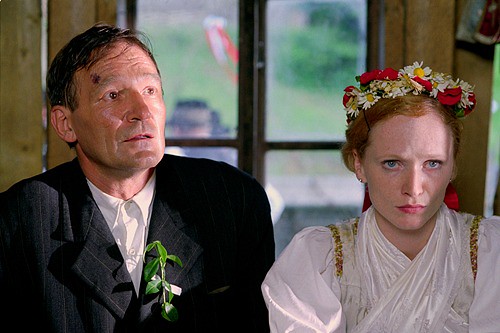
This is a beautiful epic film is set in 1943/45 in Czechoslovakia. It is based loosely on a true story about a young Prague medical student woman who is working for the resistance, and when she is discovered, must flee to the Czech boonies with an older mountain man to his tiny, tiny village in the mountains. To save herself and all who have helped her, she must marry him and somehow fit in with the village folk. The film is largely about her relationship with this man who protects her, as it changes from reserved and awkward to intimate, and about her experiences with the characters in the village.

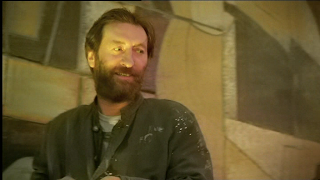
The acting is very strong throughout, so it is a bit unfair to just concentrate on the two leads, but that being said, they give very compelling performances. Ana Geislerova is perfect as the young sophisticated woman who must hide herself in this small village and to fit in must marry Joza. She wants to just cry and throw a tantrum, but she can't. This is simply what has to be done in the situation she is in. Her co-lead is Hungarian veteran actor, György Cserhalmi, who looks in the movie like a cross between Harrison Ford and John Wayne -- in real life he looks like a typical scruffy Eastern European actor pic here. Cserhalmi is perfect as the strong, taciturn, mid-50s sawmill worker.

I was floored by Ana Geislorova and Gyorgy Cserhalmi's performances (by the way, these two are *very* famous in their respective countries, although unless you are from Eastern Europe, you have probably never heard of them). The charisma and believability of their scenes together is really unusual. While I can think of many performances where an actor or actress was able to channel the emotions of a character, I can't think of many where they do this successfully with another actor/actress. The success of their performances was perhaps due to the fact that the 2 actors weren't talking to each other off the set; there was a bit of a language barrier since György is Hungarian and Ana is Czech. They basically kept their interactions to the lines they uttered while filming. In an interview on zelary.com, Ana says "Sometimes I had to smile to myself, that we [meaning she and György] were working next to each other about a quarter of a year and saying nothing to each other off the set, and at the moment they said 'action', we would jump into being all lovey-dovey and all that absolutely without any problems. We knew each other only as characters in the film...somehow it worked." (a rough translation). And on top of this, György said many of his lines in Hungarian(!!). Obviously they re-recorded him saying his lines in Czech later. I think this is part of what makes their performances together so compelling, with no verbal communication they put a lot more intensity into their eyes and body language.

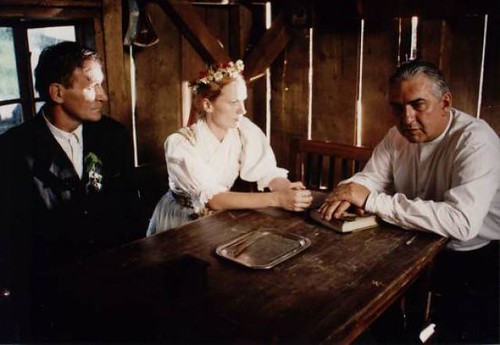
Miroslav Donutil also puts in a nice performance here that takes advantage of his wonderful voice -- he delivers a sermon. One of the best scenes is when he is talking with Joza and Hana before the wedding. He knows he is committing fraud and putting his life in danger by doing this, but the alternative is to turn in Hana, which would lead to the deaths of Joza and the town doctor. He has a monologue where he argues both sides to himself (while Joza and Hana watch rather nervously), finally with a deep sigh: "Well, I hope you're single at least." Joza clearly had not considered this appalling possibility, and his expression here is quite funny. It's a precious scene. Other films with Miroslav Donutil (the priest) that I've reviewed: Pelisky.


Other films with Gyorgy Cserhalmi that I've reviewed: Gyorgy Cserhalmi films

Labels: , ,