Pupendo * * *
 Pupendo (link to DVD on Amazon)
"One day a little tapeworm poked her head out of an anus, looked around at the big wide world. She popped back in and raced to find her mother. 'Oh, mommy tapeworm what is that great and lovely blueness that is all around outside?' 'That my darling is the sky.' 'Oh mommy tapeworm, what is that beautiful yellow orb in the sky?' 'That my darling is the sun.' 'But why mommy, why do we live here, here in the dark?' 'Oh my darling, because this, this is our HOME...yes, my darling, up someone's ass.' -- a joke told by an insurance appraiser from the movie Pupendo.
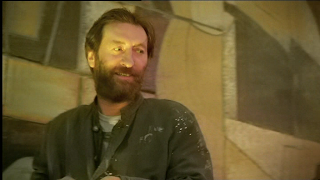
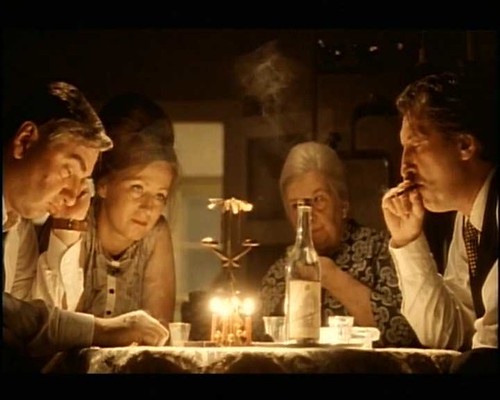
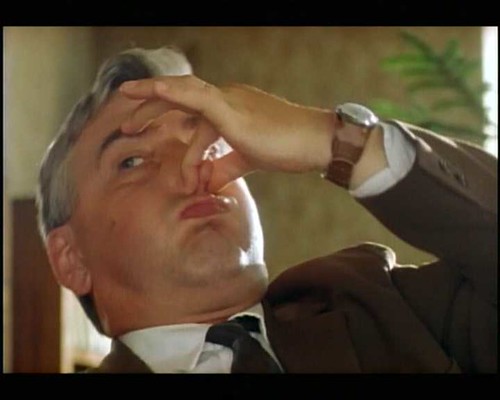
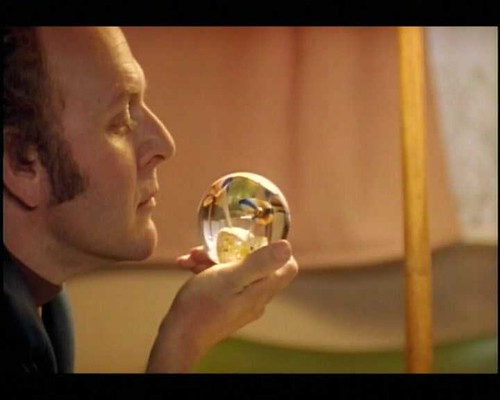
This movie is a comedy-drama about the 1980s in Czechoslovakia, and that little joke sums up the Czech perspective pretty well. Yes, we're living in crap, but nonetheless it's home. The story follows a talented Prague artist, Bedrich Mara, who in the heady years around the 1968 Prague Spring was one of the top artists in the country with his work shown in the west. But he refused to make the necessary compromises (join the communist party presumably) and has fallen out of favor with the authorities. He loses his job, is ostracized from the art community, and barely brings home enough for his family by making kitschy clay things, like a money bank that looks like a butt. The movie tells the story of a summer in which on a bit of a lark, he brings home a bum. The bum turns out to be an art historian caught at a particularly low point. And through a bitter-sweet series of events, he helps Bedrich return to the international art world -- although at costs that have a certain black humor to them.
Pupendo is by the same director that made Pelisky, and it feels like a follow-up. Pelisky was a comedic-drama about life in the summer of 1968, while Pupendo is a drama-comedy about life in the 80s. But I think one reason Pelisky was more successful was that Pelisky combined funny with a very obvious tragedy -- the 1968 invasion. In Pupendo, the juxtaposition of funny and serious is not as effective -- perhaps because the tragedy of the 1970s and 1980s, the post-1968 period of "Normalization", is difficult to capture on film unlike tanks rolling down streets. "Normalization" is an Orwellian term because it refers to squelching the "abnormal" ideas of freedom of speech and civil liberty that dominated the the attempt at humanizing Czech communism (Jan-Aug 1968). I once heard a Czech describe the difference between the Stalinist oppression in the 1950s versus the Normalization oppression in the 1970s. In the 1950s, you were executed but there was a certain logic and predictability to what activities would get you killed. In the 1970s, you were ostracized rather than executed, but punishment was completely capricious. You think you are fine, and then some innocuous comment, or forgetting to put up a flag, gets you on the blacklist.
For this reason, I think the film probably has mainly home-market appeal, unlike Pelisky which is likely to be quite funny and tragic to non-Czechs also. Also Pelisky has Miroslav Donutil, one of the most famous Czech comedic actors, who is hilarious in the movie.
 Pupendo refers to a Czech "game" in which a heavy coin -- in this case a 5kc piece which is about like a Sacajawea or Loonie -- is thrown swiftly down onto the bare belly of the "recipient". If done correctly, the coin lands flat and gives a frightful sting. Video of pupendo being played. Why this movie-vignette about life in the 1980s in Czechoslovakia is named after this slightly sadomasochist game is unclear. Presumably it is meant as some kind of metaphor, but I couldn't quite get it.
I purchased the DVD in the Czech Republic where it is widely available in video stores. Purchasing or renting it outside of CZ is difficult, but in the U.S. you can try searching on www.eBay.com; you'll sometimes find it for sale there.
Labels: communist era, Czech
posted by eeh at 6:51 PM


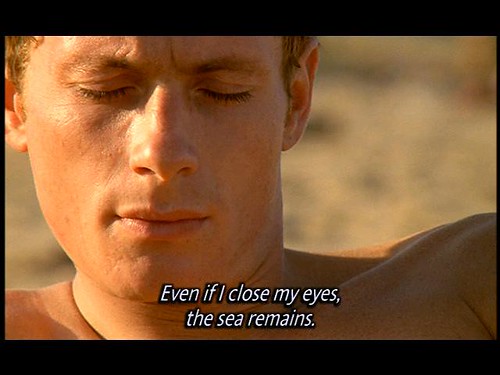 Szerelmesfilm is a 1970s movie from the Hungarian director Istvan Szabo about two childhood friends, later teenage sweethearts, who are separated when Kata, the woman, emigrates to France after the 1956 Hungarian Uprising while Jancsi, the man, stays in Budapest. Of course, in this time, travel to the West was not permitted and it is ten years until he gets permission to visit her in France. The movie is about his visit and trying to sort out his childhood/teenage memories of Kata.
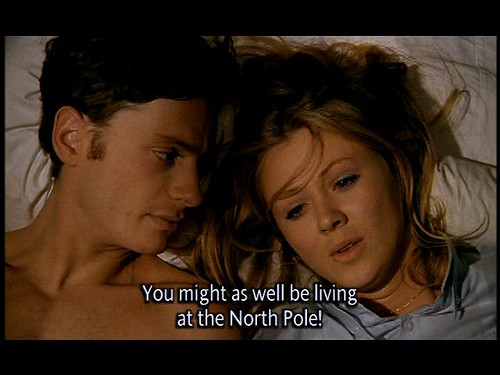 Although a small intimate story, it is ultimately about the generation born in the mid-1930s behind the Iron Curtain. They were children during WWII and grew up in upheaval and tragedy, they were young adults in the Communist era and experienced both the revolts and the resultant oppression, and finally they lived with the disappearances. People had to emigrate in complete secrecy at considerable personal risk. People would wake up one morning and their best friend or brother or aunt would be gone. And they couldn't come back. I suppose anytime that a group of
 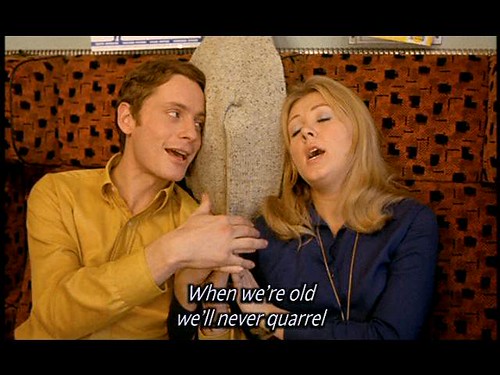 people go through difficult times together, they form a special bond and are left with a feeling that others can't quite understand them. It's a kind of nostalgia -- although we often use that word for pleasant memories. Here it is a nostalgia driven by potent memories and one craves those who were there and went through the same things.
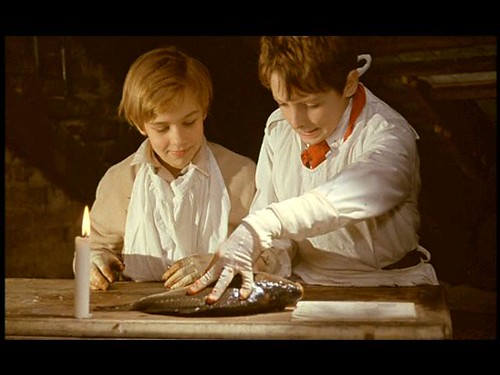
 cellar during the bombing raids. The two childhood actors that play Joza and Kata are precious and perfectly cast. The two kids get up to some funny antics, and there is a painful for them, but funny to watch, scene where there is a trial of the two by their Young Pioneers troop. They are accused of a) kissing and b) loving each other more than the troop.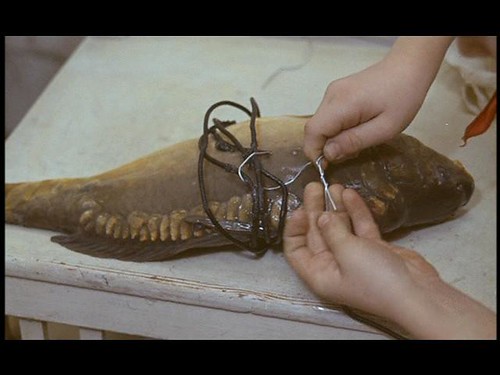
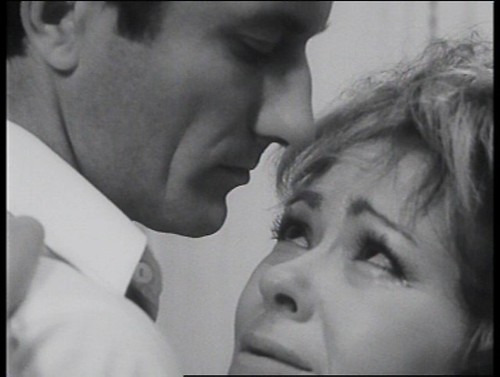 1970, Czechoslovakia. A man and his wife are returning home after a late party. They discover that neither has the house keys. They argue. He finally climbs over the garden wall and breaks into the house. What begins as an irritating hassle, evolves into a story of suspicion and panic when they realize that someone has been in the house. Flashbacks to the social gathering earlier that evening piece together the reason for the panic. The man is a high level member of the Communist party. His boss, a minister, had been arrested that very evening by the secret police; a victim of the 'shoot the messenger' reaction when he turned in his report on brickyard closures. As for the couple, while the panic sets in, a picture emerges of a family living precariously in the peak of communist luxury(*) but in an atmosphere of fear within a political world that capriciously promotes people, or strikes them down at will. They assume as a given that their house is bugged and refer often to "The Ear" --
 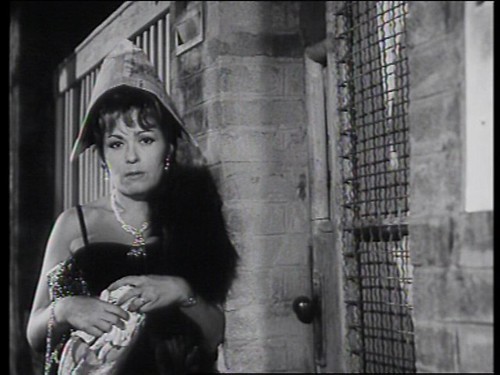 they argue in the bathroom where they can turn on the water and make love on the floor in the kitchen which they calculate is less likely to be bugged than their bedroom. The movie is the story of one psychologically harrowing night, combined with flashbacks to key conversations at the earlier social gathering, as the man tries to sort out what's happening and whether he to is to be picked up and dragged away. Random memories of remarks and incidents become full of meaning and foreboding. Claustrophobic uncertainty builds throughout the movie, and film eventually culminates in an unexpected twist.