Szerelmesfilm (LoveFilm) * * * *
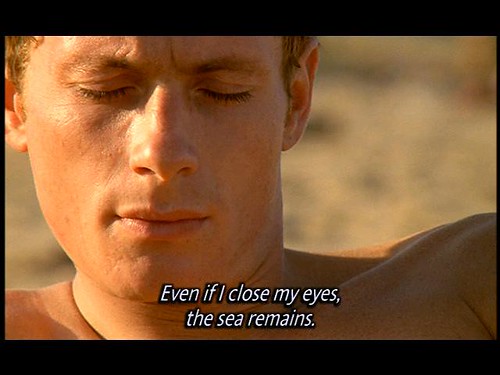 Szerelmesfilm is a 1970s movie from the Hungarian director Istvan Szabo about two childhood friends, later teenage sweethearts, who are separated when Kata, the woman, emigrates to France after the 1956 Hungarian Uprising while Jancsi, the man, stays in Budapest. Of course, in this time, travel to the West was not permitted and it is ten years until he gets permission to visit her in France. The movie is about his visit and trying to sort out his childhood/teenage memories of Kata.
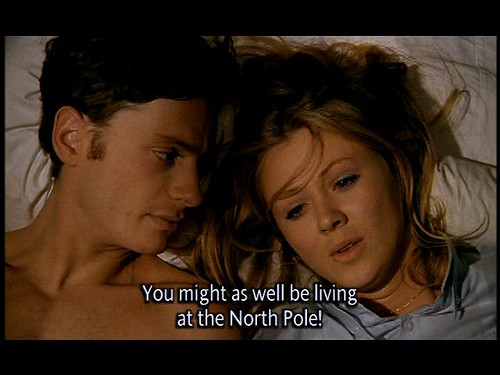 Although a small intimate story, it is ultimately about the generation born in the mid-1930s behind the Iron Curtain. They were children during WWII and grew up in upheaval and tragedy, they were young adults in the Communist era and experienced both the revolts and the resultant oppression, and finally they lived with the disappearances. People had to emigrate in complete secrecy at considerable personal risk. People would wake up one morning and their best friend or brother or aunt would be gone. And they couldn't come back. I suppose anytime that a group of
 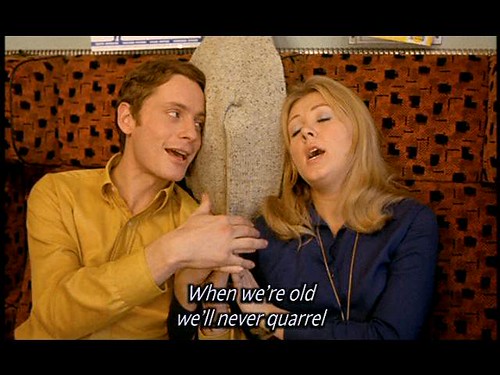 people go through difficult times together, they form a special bond and are left with a feeling that others can't quite understand them. It's a kind of nostalgia -- although we often use that word for pleasant memories. Here it is a nostalgia driven by potent memories and one craves those who were there and went through the same things.
LoveFilm is largely a montage of memories. As Jancsi travels to France and visits with Kata, things he sees remind him of things in his past or memories just jump to mind. This is done very cleverly, and although it's a little muddled at times like memories are wont to be, it's engaging. To me, this felt just like the way memories are – triggered by something one sees or hears or smells, and some memories continually are repeated. Also one latches onto certain images – for Jancsi it is the image of the green backpacks he and Kata wore when they would go down to the
 cellar during the bombing raids. The two childhood actors that play Joza and Kata are precious and perfectly cast. The two kids get up to some funny antics, and there is a painful for them, but funny to watch, scene where there is a trial of the two by their Young Pioneers troop. They are accused of a) kissing and b) loving each other more than the troop.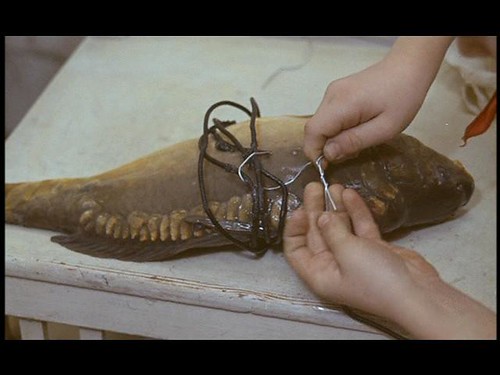
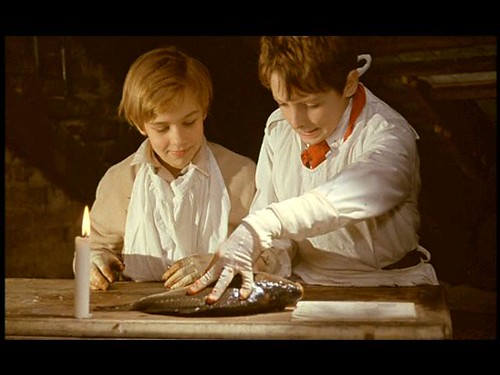
Kata and Jancsi with the fish, learning to be doctors.
I recommend it to anyone who
a) enjoys love stories and is looking for something a little different.
b) likes stories about heartwarming kids, such as My Life as a Dog or Kolya.
c) is connected to someone who immigrated – especially someone from this generation.
d) and finally it’s a must see for fans of director Istvan Szabo (Being Julia, Taking Sides, Sunshine, Mephisto)
My epinions review of LoveFilm.
Labels: communist era, Hungary, post-war, Szabo
posted by eeh at 2:19 PM