Ivan's War: Life and Death in the Red Army, 1939-1945 (link to book at Amazon)
He stands larger than life, a gun grasped firmly in one hand, his strong jaw pointing slightly upward as he fixes his determined gaze somewhere off to the left. Ivan. The WW II Soviet soldier. Any visitor to the Soviet Union has seen him cast in bronze at war memorials or seen him in WWII era placards. To readers of WWII memoirs from German soldiers, he is the faceless infantryman who yells Uhrrah! en mass and launches himself with selfless sacrifice in endless waves against withering German fire (1,2). In war, soldiers are always turned into icons -- carefully polished symbols of patriotism and heroism ... (or evil if you are talking about the enemy). But real soldiers are individuals with reals hopes, desires, fears and heartbreak not bronze statues--even Ivan. In this incredibly well-researched book, Catherine Merridale (3) seeks to find the real Ivans and tell their stories.
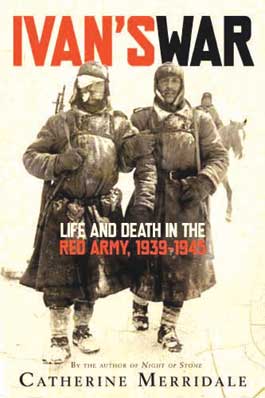
The bulk of the book is organized chronologically: from the disastrous Winter War in Finland to the victorious invasion of Germany. The book as a whole however is organized to answer three basic questions: Why did men fight, what did they think of their experience at the time and how did the war change them?
To understand these men (ok, there are few women, but mainly men), Merridale first introduces us to their world. These men and their parents were generations that had experienced violence on an unprecedented scale(5). The civil war of 1918-1921, besides creating chaos and killing many, also created desperate shortages. In its wake were epidemics and a terrible famine. That famine turned out to be minor compared to the famine of 1932-1933 when 7 million died. Then there was the restructuring of society after the civil war: collectivization, totalitarianism, and gulags for the land-owners, business-owners and intelligentsia. But the young soldiers also grew up in a state that sought to remake souls--to remake youth into heroic communists. This last point is very important. Those born from 1921 on, were born into a state that saw as one of its great missions the education of youth and the lifting of people out of poverty. To be a "good Communist" was to devote oneself to the betterment of society, to be upstanding, moral, and clean, and to do heroic deeds. At the same time, the experience and views of the men were anything but uniform. Many men came from regions that did not support Russia--the Western Ukraine and the Balkans for example. Others served in punishment battalions as a way to do penance for their family's capitalist crimes--or for more mundane crimes. The idea of a unified country standing together against the Germans is a myth of the Soviet state(6). One of the strengths of Merridale's book is that she tells the stories and experiences of men from many different walks of life. Many were your idealist Muscovite, others were village boys, some were from Russia and others were not. Their experiences as soldiers were also diverse: she tells the stories of men who fought on the front lines on the ground and in the tanks, of men who ended up behind the lines and worked as partisans, of men who survived the punishment battalions, of Jewish men, of ardent Communists, of non-political men, and of a few women.
Why did men fight? When Merridale first posed this question, my reaction was, "Well, duh, they were conscripted and would be shot if they didn't fight." She argues however that terror-tactics produce a very poor solider--the normal response being to hide in one's foxhole or to be incapable of firing. British, German, and American armies create the will to fight by promoting very strong bonds within small groups--after a few battles and losses, the men fight with passion for their close comrades who, through the crucible of fire, have become closer than family to them. Making them feel they are fighting a good cause is good for morale, but does not create the kind of heroic fighting necessary to win wars. What Merridale notes right off the bat is that the Red Army was not organized this way. The traditional military structure had been replaced with an ideological structure. This was an army where men were supposed to fight for the international proletarian and to die for their fellow soldier, whoever he may be, because of comradely friendliness. If one's takes this propaganda at face value, the men seem like mindless robots. Of course dying for the international proletarian is a fine idea if you are agitating in on a street corner; in the heat of battle, nobody is going to rush the enemy for that! Secondly, Soviet battle groups experienced severe losses in battles. Loss of 80-90% of men in a combat group was very common(4). Thus for both political and death rate reasons, strong bonds between small groups of men were discouraged.(8) So the question remains what motivated these men to rush the lines and pull the trigger? The simple answer is that an army run by political officers and not military officers is a pathetic army. The Red Army up to 1942 had huge desertion and panic rates. In the winter war against Finland, 50% of men were captured, missing or killed. As the Germans rolled over Russia, men fled en masse and refused orders to fire. Even the Germans were surprised by the chaos, notes Merridale. Thus much of the first half of the book is about is was like to be in a losing chaotic army--and how does a man react when he can see with his own eyes how terribly mismanaged the war is and how cheaply lives are treated. The feeling clearly changes in the 2nd half of the book and the 2nd half of the war. The army is reorganized under more traditional military not political leadership. Training and tactics improve. Men develop new resolve. Letters from the 2nd half of the war are characterized by determination, resolve and hatred for Fritz.
"I have to say that the war has changed me a lot. War does not make people tender. On the contrary, it makes them reserved, rather coarse, and very cruel."(7)
Part of the drive to understand the man in the Red Army in 1938-1945, it must be said, is to understand what happened in 1945 in Budapest and worse yet in East Prussia. War makes one cruel and innured to death and brutality, but there are many records of officers being alarmed and startled by what happened(9). War atrocities are nothing new. All wars are have instances where women and girls are gang-raped and then shot or where a large group of civilians are killed and mutilated. What was different about Budapest and East Prussia was the magnitude, extent, and commonness of these types of outrageous brutalities. The solidier that did not participate was the exception not the rule. The reports from civilians all over these regions are chillingly similar: a white hot fury descended upon them that went house to house exacting revenge. This seemed to be a spasm of brutality. Merridale spends a whole chapter, with the lovely title of Despoil the Corpse, to understand what caused men spread across different battle groups and across large geographic regions, to do this. This was not an isolated event in one battle group. She attributes it to the terrible strain of war and loss into which was mixed hateful propaganda, implicit and explicit encouragement from above, and inadequate commitment to discipline from officers. After they soliders passed farther into Germany, their behavior was less horrible. Most women were raped, but not gang-raped to death and rape in front of one's family was less common. Children and old people where not generally killed, and certainly not mutilated. Merridale says that in her interviews with veterans they were exasperated with this focus on rapes of German women. They spent years fighting in horrible conditions--that is what defined their experience. Yes, the brutalities were terrible but they had already become so inured to death and cruelty. The rapes and rampage of 1945 was, from the perspective of the war as a whole, a brief and not particularly memorable part of their experience.
This book is a must read for those interested in WWII--the overwhelming majority of which was fought on the Eastern Front. You won't learn about tactics, about troop movements, or about equipment. After reading this book however, you will see the person behind those nameless Red Army faces. This book also helps us grasp the enormity of sacrifice and suffering. 27 million died in the war of which 8 million were Red Army soldiers, but I think the losses are better summed up by another shocking statistic: 90% of men who turned 18 in 1939 (born in 1921) died as solders in the war.(10)
Footnotes:
1,2. Some example memoirs that I've read recently are In Mortal Combat by Bidermann and Blood Red Snow
3. Merridale, from England, is a Soviet historian. Her previous book, Night of Stone, was about how Soviet people dealt with death in the pre- and post-WWII eras. She focused on the deaths and disappearances of people arrested and sent to Gulags (millions and millions). How does a nation of people deal with death when they are forbidden to grieve?
4. Evgyny Bessorov was a platoon leader in the Soviet Army and wrote the memoir, Tank Rider. In basically every major battle, he lost all but a handful of men in is platoon. Then he would get a hodge-podge of replacements for the next battle.
5. 15 million died in the 2 decades before WWII.
6. Merridale and Bessorov mention many cases where the soldiers were not greeted warmly by the civilian population. Bessorov says they almost starved when they were sent as recruits to dig potatoes since the villagers refused to share food. In some instances, peasants rose in rebellion against the Red Army as in Kursk when the army tried to remove them from the front lines.
7. Written in 1945 by a soldier. pg 381
8. The exception seems to be the tank soliders who formed very tight bonds as they had to work as a well-oiled team. They also had very high death rates. According to Merridale, of 403,272 trained, 310,000 died. Interestingly in Tank Rider, Bessorov repeatedly talks of the tanks drivers being scared and holding back.
9. Both Beevor and Merridale give examples of reports from officers and political officers.
10. p 338
Labels: Eastern Front, Russian, WWII
 Come and See (link to DVD on Amazon)


 This is a memoir of a young German soldier who started as a landser—infantry man—manning a heavy machine gun and then became a platoon leader. He began his service in the Crimea in a battle group that defeated the Russians and pushed them out of Sevastapool Castle. They were later moved up to join the army besieging Leningrad. They battled the Russian groups trying to break the siege. Later as the Russians pushed the Germans south, out of Russia, they were surrounded and trapped in what was called the Courland pocket. Against overwhelming odds, they resisted all attempts by the Russians to smash their pocket. They held out till the end of the war, when they were finally ordered to surrender. The author was taken prisoner and was one of the few to survive the gulags.
  Tank Rider is a war memoir from a man, Evgyny Bessorov, who served in the Russian infantry during WWII. He was the lowest level of officer, a platoon leader. It was his job to get the soldiers up and rushing at the Germans during the endless battles. He rushed into battle for 2 years carrying usually only a shovel, which he used for its intended purpose (digging in) and to 'tap' the butts of soldiers who had been laying on the ground for too long. He said of his job, no one wants to die, that includes soldiers, it was my job to get them up and running at the enemy. Sometimes he had to physically manhandle his soldiers out of their foxholes; only once did he have to threaten execution. He led his men through 4 or 5 major battles. During each he lost about 80% of his platoon. His survival was pure luck combined with caution.
 From there, it is a relentless 2 year push towards the German border and then into Berlin. He is part of the troops the encircle Berlin from the east. Here he is injured and then rejoins his battalion when they are outside Prague. And then 'Woina kaputt'...the war is finished.
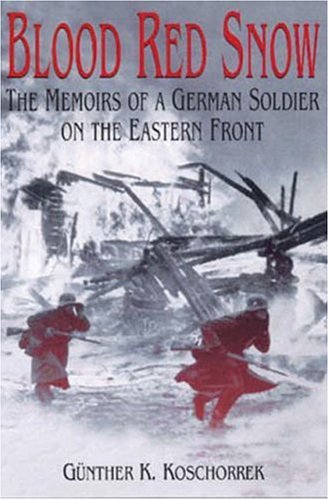 Blood Red Snow is memoir of a German soldier who fought as a heavy machine gunner in Russia, Ukraine and Romania. He also did a short stint in Italy, chasing partisans. This story is very different than A Stranger To Myself. No endless philosophizing or ruminations on the glint of snowflakes against the sun. Instead this is a straight-forward story of what happened to him as an elite front-line soldier.
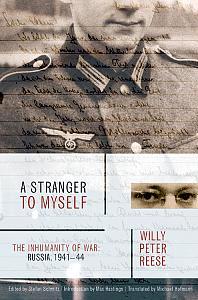 A Stranger to Myself is a book made from the diaries of a young writer/poet/philosopher who died in Russia on his 5th tour on the Eastern Front. This is a memoir about what it was to experience the Eastern Front as a little human not an uber-German. If you've seen any books on the Eastern Front, you've seen the pictures of the winter of '41. The German soldiers in summer uniforms are laying in endless frozen heaps. The walking have their hands and feet wrapped due to frostbite. It is a disaster. Reese entered the war during that winter and lived through the experience in those pictures. He also was on the front near Kursk during the disasterous winter of '43 when Germans were again pushed back. 100'000s German soldiers were killed or froze to death during that winter. He returns to the front in winter '44 as the Germans are getting pushed out of Russia after the failure of Operation Citidel. So this is a memoir of the winter defeats. He misses completely the heady summer of '41 when the Germans pushed to Moscow and the summer of '42 when they pushed to Stalingrad.
 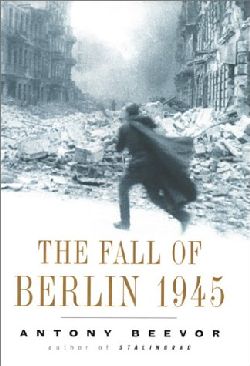 The Fall of Berlin is the follow-up book by the author of Stalingrad: the Final Siege. TFOB starts as the Russians cross the German border in East Prussia. For those who are spotty on their post-WWI geography (meaning 99.999% of us), Prussia was is in the Baltics (meaning up by Lithuania) and extended across modern day northern Germany (formerly East Germany), Western Poland, parts of Lithuania, and far southwestern Russia (parts it annexed after WWII from Germany). Much of the first third of the book is about the invasion of Prussia and the attempts by civilians to escape. This was especially interesting to me because I know someone who's mother and grandmother were among those civilians. About 1/4 million civilians were trapped in Konigsberg at one point, completely surrounded by the Russian Army. My friend's mother was trapped there and was among those that crossed the ice of Frisches Haff (a bay) on foot to reach a small spit of land that the Germans still held. From there they walked into Germany through a thin corridor of German-held land to East Germany. Later after the Germans surrendered, they escaped from East Germany to the West.
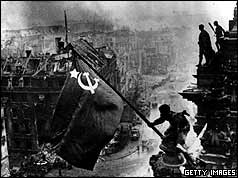 Surprisingly this part of the book was not terribly interesting (for me). Lots of space is devoted to troop movements (yawn). You don't get a sense from the book about what the civilians in Berlin went through. This is surprising since there were many diaries published from that period. For some reason, this part just seemed a bit mechanical. Basically, the sense you get from the book is that Berlin fell without much of a fight in the city proper and then people started getting on with their lives. That's hard for me to believe. The city was reduced to rubble and the depression among the people must have been extreme. My next book is "A Woman in Berlin" which is a diary from the 9 days of the battle. I expect that this book will give a different picture.
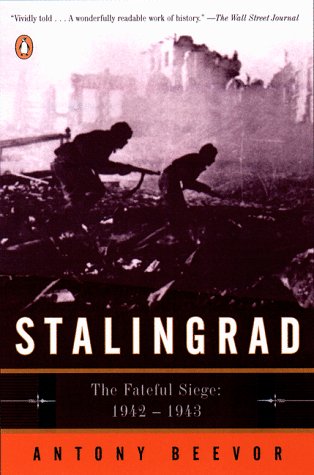 The battle for Stalingrad was the bloodiest battle in the brutal battles on the Eastern front. After surviving a brutal winter and unsuccessful attempt to capture Moscow, the German Army turned its attention to the east and the Caucaus oilfields. They raced forward rapidly in a headlong rush of one success after another. Then they reached the city of Stalingrad on the banks of the Volga. In difficult fighting they managed to capture 95% of the city, but the Russians held on the the north side of the Volga River and a small strip of land on the south side. For months, the Russians and Germans fought a pitiless street battle in the ruins -- while each day winter got closer. In late November 1942, the Russians executed a large counter attack and successfully surrounded the entire 6th Army, by then numbering only about 250,000 men. The Germans were unprepared for winter, and over the next 2 months, they slowly but surely starved to death. When they finally surrendered in early February 1943, they numbered only 90,000. These were taken prisoner and only about 6,000 managed to survive captivity and make it home.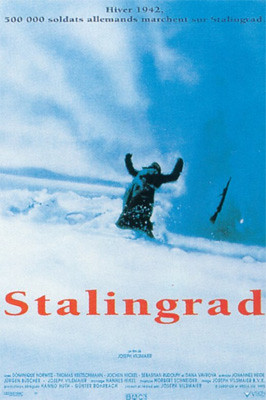

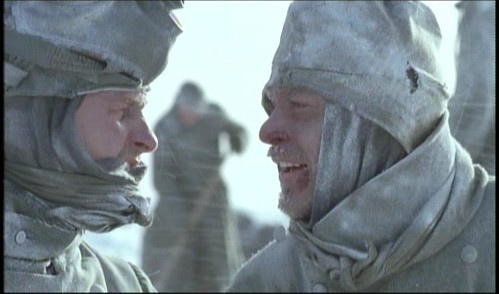 The film follows a company of German soldiers, storm troopers, who have just finished fighting in Africa and are sent to the battle for Stalingrad. The film focuses on a group of about 6 of these men from this company (well, the core focus group starts larger but their numbers keep getting smaller). We see them as they arrive in the midst of the battle. They step off the train into hell, walking past a long line of severely wounded men and Russian POWs being beaten to death. Less than an hour after their arrival, they are in intense close urban combat. I cannot say how realistic these scenes are, but they are certainty some of the most gripping that I have watched. But they are not heroic pictures of combat. It’s ugly, scary and men soil their pants. As the movie goes on we follow this core group through battles, an overly harsh punishment involving loss of rank and work on mine removal, the deepening chaos of the German army as they are surrounded, desperate battles against the Russian tanks, and finally the collapse of the German army in Stalingrad.
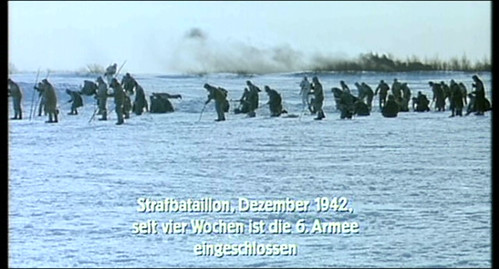 The percent of the total population killed in WWII was approximately 10% across Central & Eastern Europe, with Poland and the Soviet Union on the high end with ca 15% of the population killed, Germany in the middle at 10% of the population killed and Czechoslovakia on the low end with 2.5% killed. In contrast outside of Central & Eastern Europe (UK, France, Spain, Belgium, Norway, Denmark, Spain, etc), approximately 1% of the population was killed with France on the high end at 1.3%. So I wanted to watch the film to gain a deeper understanding of the impact of war on this region.
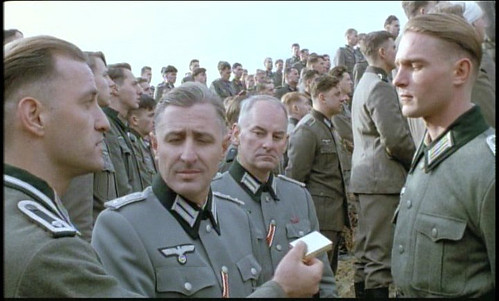 One of the things that struck me in Stalingrad was the portrayal of the German officers as cruel to the German soldiers. Traitors (those that try to escape by injuring themselves) are summarily executed. A high level officer hoards a warehouse of food while the soldiers starve. We see a scene where dead soldiers are being burned in a big bon fire. The camera lingers for a moment as a dead soldier is thrown onto the burning stack. A group of soldiers threaten a doctor to get care for their friend and are court-marshaled and sent to work on land mine removal. Much like in Downfall, there is a sense that the common solider is there simply to be slaughtered. Individual life is not valued, and soldiers have meaning only in aggregate as little flags that are moved around a map as a division. However, in Downfall this sense of the soldier as mere cannon-fodder comes mainly from Hitler and the generals find this view appalling, whereas in Stalingrad there are high-level generals on the ground with this attitude. In fact, one of the generals in Stalingrad is so nasty, cruel and cowardly, he seems to have been cast from Indian Jones and the Lost Ark. In Downfall, this is not the case, the generals are uniformly professional, courageous and dedicated to the troops. Nonetheless, one detects, like in Downfall, a seething anger about WWII and about the enormous casualties of young German men. Towards the end, one soldier berates an officer who objects that "I'm not a Nazi", that he is worse than a Nazi because he went along with them even knowing how it was going to end.
