Written by Kaja
A paper inspired in part from a visit to Sunnyside and joint viewing of many of the following films. The other part of the inspiration was a writing assignment in a class on societal perceptions of conflict. Links are to EEH's reviews after Kaja and EEH watched the films together.
Societies are founded on myths. Whether myths of origin, homogeneity, parity, or freedom, most are constructed and integrated into a society’s precepts based on hindsight and introspection. War myths are integral in a society’s identity and, as such, feature prominently in the form of combat movies. Presentations of war by the media within different countries co-vary with the kind of involvement a state had in the conflict. Factors such as winning and losing, whether a conflict was fought at home or abroad, and collateral damage all bear on how the conflict is represented retrospectively in film. For instance, Germany lost the war, fought on native soil, and suffered massive civilian deaths and as a result, German representations of WWII illustrate absolute war, lack heroism, and demonstrate blame-shifting. Conversely, the US was victorious, fought abroad, and suffered few civilian deaths. As such, American WWII representations consistently present a degree of romantic war, ardent heroism, and moral superiority. Russian war films, however, display similarities to both American and German representations of war. While Russia was victorious and display moral superiority and heroism in WWII representations, the massive civilian casualties prompt portrayals of war as absolute, incomprehensible, and tragic.
In all three of these countries, retrospective representations of WWII remain consistent over time because of film’s capacity to address underlying social tensions and continue to fight the home front battle.
As products of their socio-economic and historical past, directors speak to particular demographics, ideologies, and/or identities. Whatever the intentions filmmakers have, they present in their movies their own visions of an aspect of the larger social reality, even if the effect is unintentional (Sobchack 283). Of particular interest is the “realist” approach to film as a medium for reflecting “real life,” either as it objectively exists or as it is reflected in the minds of the film’s heroes (Shlapentokh 4). These “realist” movies do not allow a viewer to avoid fundamental tenets of the film such as themes of anger, religion, racism, etc. War movies are “realist” movies because they explicitly address a salient feature of societal history. As such, there is a link between these “realist” movies and the inferences one can draw from them.
Germany
Germany’s World War II losses were significant. Of the 69 million German inhabitants prior to the war, approximately eight million died (~5.5 million soldiers and 1.8 million civilians) at a ratio of 108.2 deaths per thousand citizens. Ostensibly, the devastation was all encompassing; it obliterated not only the industry, economy and fundamental infrastructure of the German state, but also destroyed civic pride and cohesive identity. In light of this desolation, Germany’s first task was to establish an estimable position within regional and world economy. However, restructuring the German identity was more difficult. Because the Nazi ideology was closely tied to a traditional Deutsches Kultur such as Volk and traditional heritage (ex. songs appropriated for propaganda purposes), there was no identity refuge upon which Germans could rely. Vergangenheitsbewältigung is the process of coming to terms with the Nazi past (Hake 87). One of the ways which German vilification is attempted to be resolved is shifting the blame to a higher authority, thus attributing the actions of an individual, his country, and his culture to the perversion of the individuals controlling the system. Milgram’s experiment, which examines the effects of authority on individual behavior has helped to justify this transfer of blame (Helm 322-330). When revisiting World War II in film, the Vergangenheitsbewältigung aspects of blame shifting, totality of war, and absence of heroism are consistent across time and space within the context of the conflict portrayal.
Die Brücke (The Bridge, 1959) follows the story of a group of German boys ordered to protect an insignificant bridge in their home village during the conclusion of World War II. Indoctrinated into the Nazi ideology, each of the seven boys has their own reasons for joining the ranks of Wehrmacht. One joins to protect the fatherland, another to spite his father, and another succumbs to peer pressure and ignores his misgivings about fighting. The range of motivation for joining the war signals to viewers the multiplicity of motivations that brought able bodies to the war. Through these varied motivations,
Die Brücke presents the identities of soldiers as breaching the confines of the Hitler Jugend mold.
Ironically, the boys’ professor—the very one who indoctrinated them into the nationalist ideology—staunchly opposes the war and pleads the commanding officer to not waste the boys’ lives. Heeding this call and acknowledging the pointless loss of young life, the young soldiers are left behind with an experienced officer. Their stationed location, we discover, is the very place that they had played war games only a week before. In the face of the approaching American army and retreat of cynical the Wehrmacht troops, the absurdity of the situation increases. The fatherly commanding officer is shot by a patrol while getting coffee, the boys systematically die while facing the American army, and finally, the two surviving boys prevent the strategic bridge demolition that had been initially planned by the Wehrmacht. As the closing narrative scrolls across the screen, the viewers are told that the bridge had no value whatsoever. As such, the tragic death of every character, from the commanding officer, to the American soldiers, to the Wehrmacht patrol, illustrates the film’s underlying message: there is no redeeming quality to war—it is pointless.
More recent films, such as
Stalingrad (1995) and
Untergang (Downfall 2005), reinforce the message sent by
Die Brücke.
Stalingrad follows a company of German ‘storm troopers’ sent to fight in the battle for Stalingrad having just completed a tour of duty in Africa. The importance of the city was contingent upon its function as a Russian transport point for oil and supplies. Germany’s defeat at Stalingrad marked a tipping point in the Reich’s war effort. Stepping into the midst of a hellish guerrilla-war, absolute, random, and gritty battle permeates the images that flash across the screen. In addition to the graphic portrayal of war, the film highlights a recurring clash between ranking officers and soldiers. While in die Brücke the commanders closest to the ground were sympathetic and the indictment of the war as a whole translated into an indirect anathema on the leaders, the conflict as it is portrayed in Stalingrad is visceral. One general not only practices sadism on a personal level, by torturing and executing captured Russians, but also forces his perverse pleasure upon the protagonist. This same general starves his soldiers, but simultaneously hoards enough supplies to feed the entire army for a week in a private warehouse.
The protagonist is a young German officer who realizes that it is necessary to break from the rules in order to serve his troops. Over time, he changes from an optimistic commander to a shriveled husk; this parallels his shift from a romantic view of war to a realistic perception of war. The commander’s singular goal becomes escape and he sinks to all levels to try and return home from what he deems to be a nonsense war. The perverse nature of war and the sadist general are aptly illustrated when the sadist general crumbles into insecurity when his authority is no longer obeyed. In the closing scene our ‘hero,’ seriously wounded in both legs, freezes to death, sitting in his comrade’s embrace. This film, through degradation of the protagonist’s character, shows the lack of heroism in German portrayals of World War II. Additionally, the sadist general illustrates the causes and havoc wreaked upon the populace by a deranged leadership.
Untergang marked the 50th anniversary of Hitler’s death at the conclusion of the war. As such, the film addresses the ultimate figure responsible for the German nightmare. It is a tribute to Hitler’s mental degradation and moral dilemma. The events of the movie come at a time when the Clausewitz plan is being implemented and the city is in uproar, having just been declared a front-line city. Constantly faced with his shaking hands, Hitler’s desperation deepens as he continues to hallucinate about the 9th army as the last source of hope for those left in Berlin. Architectural models only serve to remind both Hitler and the viewers of the “true-greatness” that he had had planned for the Third Reich. Now, on the eve of the Reich’s fall, these legacies of Germany’s greatness, are undermined and left unfulfilled. The portrayal of Hitler himself is riddled with controversies. Caught between realizing his atrocities and reconciling the image of a disintegrating individual, viewers are torn between hate and compassion for this perversion of a seemingly fragile mind. However, the fervor with which the Hitler Jugend fight for and commit suicide for the Nazi ideal and their personal dedication to Hitler himself, reminds one of the tragic loss of an entire generation of youthful promise. Notably, one SS soldier epitomizes the underlying guilt presented throughout the film: “just because we are soldiers, does that mean we stop thinking?”
This question strikes at the core of the issue as it is presented in
Untergang.
Who is to blame for all of these events, the German people for doubtlessly believing in Hitler, or leaders such as Hitler who led the country down this path in the first place? Confronted with desperate dancing and drunken festivities as the allies approached, Hitler provides a response to this question with two telling statements: “what are young men for,” and “if my German people fail this test, I will shed not one tear for them, they deserve nothing else.” In the first quote, life has lost its meaning and soldiers merely serve as cannon-fodder and thus undermine any and all eloquence about the nobility of war, which he espoused earlier in the film. The second quote, directly challenges the assumption that the events are his responsibility. In essence, this second quote is a rebuke and reprimand of a nation that had placed in him great faith. Ultimately, nothing matters to Hitler. To him, it does not matter if everything is destroyed. When “compassion is a sin, [and] weakness is a sin,” then we know that blame for a national betrayal is a mantel of guilt and authorship firmly imparted by the current generation upon past leaders.
The German portrayal of WWII wrestles with issues of responsibility, reconciliation, and rebuilding. Even in a film as recent as
Untergang, the salient issues are still present. In all three movies war has is devastating, illogical, and entraps the entire society. Shifting the blame to crazed leaders, either Hitler himself or other authorities, these leaders guide the precious and impressionable youth of the country to inevitable death. There can be no redeeming quality about an event which brought so fundamentally changed the fiber and course of history. These three aspects are represented so as a direct result of the absolute defeat in the war. It is my believe that certain factors, such as combat portrayal, can change depending on military involvement in new conflicts. Therefore, were Germany to become more militarily active in the world’s wars, then gradual shifts in presentation would occur. As it is, however, overwhelming emotions of resentment and betrayal seem to still permeate German society, especially in the context of
Untergang.
Another German war film that illustrates these themes is Die Moerder Sind Unter Uns (The Murderers Are Among Us 1946), which was the first film made in Germany after WWII.
America
In contrast to the devastating effects that German society faced in the wake of war, the US experience was quite different. Not only were the casualties much lower than in German and Russian counterparts (under half a million), but the civilian population remained unscathed by the physical mortification of being present in a war zone. The loss of life averaged only 3.2 per thousand Americans and the war remained a strange and distant event separate from daily life. American involvement in the war dictated that a different set of portrayals be present in its film presentations of battle.
The war was presented as a moralistic war; it was valiant, relatively organized, and bloodless. Recent films have included more gruesome depictions of violence; however, they continue to present the effort as heroic and morally just, even if somewhat less pristine.
Because the US victory sustained a relatively small number of casualties, Americans have come to view the war years as a “golden age” when “a can-do generation of Americans solved the world’s problems” (Dickran 719). Thus, the war was not only a necessary war, but a “good war” as well, justified in retrospect on victorious humanitarian grounds. After all, victor’s justice and rationalization “after the fact as the ‘best war ever,’ redeemed its negative social impact” (Dickran 723). Because of mass media technology, Hollywood movies and photojournalism were forms of cultural production that could address the broad impact of the war on American society.
Ultimately, WWII films are about living and dying, and what constitutes a good life (Basinger 80). The combat movie genre, at least in the US, definitely had addressed questions of ideology as the justification for involvement: “if you had to die young, what would make you a noble sacrifice and what would make it all a waste? What about killing? If you had to do it, did that make you a killer? What about when the war was over, and you returned home, having killed? Would it all change you forever” (Basinger 80).
Ultimately, the answers lie in the film representations themselves.
Saving Private Ryan (1998) was an “occasion for another solemn encounter with the meaning of World War II and should be understood as a last acknowledgement of…a face-to-face salute to the surviving warriors” (Doherty 301). According to Doherty, Saving Private Ryan is best understood as a firm acknowledgement of that generation’s commitment and accomplishments and as a “final act of generational genuflection” (301). With a tag line, “in the last great invasion, of the last great war, the greatest danger for eight men…was saving one,” viewers understand that Saving Private Ryan is the ultimate heroic ideal, romantic in every sense. Smacking of “leave no man behind,” the portrayal of the conflict is un-realistic in the one sense of singular soldier retrieval.
The tale is bracketed by the present-day time frame of a graveside visit at the Normandy Memorial Cemetery and by a pair of furious combat sequences. The entry into purgatory begins with a battle overture depicting the Allied landing at Omaha Beach. A man’s intestines spill out of his gut, a face blows apart, a dazed GI with a bloody stump grips his detached forearm, and a wounded man suddenly disintegrates into a shredded torso. These are the terrors, which confront the viewer at home, harrowed by the graphic representation of the war on film. Watching the movie, I could not help but wonder what it would have truly been like; would I display the same seeming resolve and heroism that was flashing before my eyes? As Captain Miller screams, “Let’s get in this war!” the soldiers surge forward into what seems like the apocalypse.
There is a combat squad formed to save Private Ryan: an idealized leader, a grizzled veteran, a tough guy, an Italian, a Jew, a compassionate medic, a sniper, a clerk, etc. Private Ryan is himself from Iowa and captivates the heart of the country. This group composition uses broad strokes to cover most American stereotype and to endear and personalize the cost of war. Subsequently, each character is sequentially eliminated and brings the message of devastating, but heroic war to the home front.
Russia
Russia holds the position as a hybrid in style. While Russia emerged as one of the three main victors of World War II, it suffered by far the largest military and civilian casualties of any other state. This is an attribute not only of Russia’s proximity to Germany and the invasion tactics employed by the Germans, but under-equipment and inexperience. As such, the social repercussions of fighting for the motherland and being successful in their endeavors manifest themselves in having fought a heroic just war, but with the underlying current of devastation and war tragedy. During Stalin’s time (1929-53), cinematographers had to obey the official ideology regardless of their personal convictions and ideals. However, after Stalin’s death and the liberalization of the regime (1954-85), film directors were finally able to somewhat express their own views of the world (Shlapentokh 16). Because of the regularized nature of films produced prior to 1953, I will focus on movies that were released during this “liberalized” era.
The narrative of
Ballad of a Soldier (1959) is forthright. A soldier shoots and destroys two tanks, he is commended with four days leave, and he travels home to fix his mother’s roof. The majority of the film takes place on a train and highlights the mechanics and process of returning home. Aloyosh, the soldier, is a character that is identifiably Russian. With Russian height, hair, and build, he heralds the development of a new type of hero within Russian cinematography: true Russians (Shlapentokh 140). As this new type of hero, he embodies a lack of formal education, is good natured, from the country, and dies a hero’s death in an act of martyrdom and symbolic Russo-Christian ordeal (141).
Aloyosh continues on his journey, one sees through the wagon windows the devastations of war (burned houses, poverty, discarded machines), but his optimism does not wane. Here Aloyosh is a hero, but he is a hero of everyday life. His form of valiance does not manifest itself through zealous disregard for his personal safety, but instead posses a quiet perseverance that appears to be able to get him anywhere, given enough time.
Unfortunately, as Aloyosh arrives at home, he only has time for one quick embrace, a kiss, and then departure. Using panning and low-angle shots of his lonely mother, the angles bring a particular emotional aspect of the movie. The low-angle shots establish the dominance of the mother figure, and the pan-shot establishes the bleak landscape that Aloyosh left behind (Dick 12-28). In Russian culture, the mother figure is a particularly strong and important figure; this film in its construct and execution strongly reaffirms this fact (Gillspie 136).
The epilogue poignantly annotates the underlying devastation of war: “This is all we wanted to say about our friend, Aloyosh. He could have become a splendid citizen, he could have decorated the world with gardens. But he was, and will always stay, in our memory as a soldier…a Russian soldier.” The non-specificity of the tale—we are never told anything about his background, life story, or even hobbies—is such that the film speaks to as many as possible and justifies the loss of many young men who died protecting their mothers and, allegorically, the motherland.
Mikhail Kalatozov’s Cranes are Flying (1957) outlines several aspects of war: protection of the homeland, heroism, and premature death. What is particularly intriguing is that the hero dies without killing any of the enemy and it is quite possible that he dies without firing even one shot. Yet, he and his comrades are bearing arms. This implies that enemy contact is imminent and that losses are anticipated on both sides (Shlapentokh 136). All of the film’s main characters are patriots, imbued with a heroic desire to defend their homeland and personal lives. Each has his own private life, complicated relationships and strong morals, which only reaffirm his position as a common citizen, not a soldier reared in a crucible of hell.
Each character comes from a diverse background. A father parts with his family, an intellectual parts with his wife and colleagues, and the hero—Boris—waits among the crowd to bid his fiancée Veronica farewell. As a volunteer, he wants to defend her and the motherland which she embodies; however, they are unable to meet. The hero’s eventual demise, as is consistent with the hero/tragic war duality, demonstrates that Russia’s victory will not lessen the tragedy of an individual’s death or of the collapse of a dream for familial happiness. However, once more, despite the war’s obliteration of his life, his death takes on meaning because he actively protected the lives of others (Gillspie 136). His death occurs on a very personal level. Focusing on the feelings of the mortally wounded hero, Boris’ dying thoughts are of marriage and Russia’s victory. Although his life did not individually save the country, the continued emphasis in Cranes are Flying on aggregate sacrifice, reaffirms the justification of the heavy casualties absorbed by Russia during WWII. Russia is saved from the Nazis so that other people may enjoy their personal and private happiness.
Elem Klimov’s Come and See (1985) departs greatly from both Cranes are Flying and Ballad of a Soldier by inviting the viewer to witness Nazi atrocities in occupied Belorussia as experienced by the protagonist, Florian (Flor). Flor is an accidental participant in war, a naïve draftee. His mother, left alone with two small children, is unwilling to see her “man” go with the partisans, who at first seem quite sinister (they are portrayed as jaded and amoral). He is a survivor and eyewitness to some of the Nazi atrocities: German soldiers herding villagers into a church and then setting it on fire and tossing back inside the young boy who attempts to escape; dozens of corpses of recently executed villagers are heaped at the back of houses, caught on camera as if by chance. Flor’s mother and sisters are among the dead and after seeing them, staggers off with a few survivors. These men are ambushed on a field as they milk a commandeered cow and only Flor survives. An elderly peasant tries to lead him to safety as the Germans move in and massacre the inhabitants of this village, too. After the debacle, a group of partisans arrive, capture, and execute some of the merciless and barbaric Germans responsible. The manner in which Klimov manipulates his audience, is such that the subsequent cold blood execution of the Germans causes relief and a sense of partially implemented justice.
However, the absolute grotesque massacres and Flor’s trials and tribulations see the development of Flor into a hero.
The representation of brutal war presented here, as opposed to Ballad of Soldier and Cranes are Flying, breaks with the trend seen before. As Suid proposed to be the case of Vietnam on American media, I would suggest that the Afghanistan war had a similar effect on Russia’s portrayals of war—merely to a more polarized extreme.
It is striking that the social repercussion of war on society never seem to leave us. With Russian WWII cinema there is was an emergence of the ‘True Russian,’ or a hero who does not represent a socialist society so much as to embody Russia (Shlapentokh 140). Boris and Flor both posses these attributes, however, Aloyosh in
Ballad of a Soldier embodies this Russian form of heroism. According to Shlanetokh, these promotions were not perfunctory, but intentional in constructing a Russian identity, because “cinematographers felt it their civic duty to describe truthfully some aspects of their society [and] also wanted to send moral messages that ordinary people would not find in official mass media or education” (Shlapentokh 129). Within the context of making movies that deviated from party guidelines, it is important to remember that antiwar films were seen as tools for dissident behavior (Culber 88). As such tools, the texture, nuances, and messages found in these movies take on greater significance.
Conclusion
Movies are a part of culture and are reflective of shifts in perceptions. If one society is more prone to glorifying war and violence, the trend is predicated on past events and carries through from one generation to the next. Films not only help to reinforce these changes, but also act as chronicles of these changes over time. In the context of WWII film representation, the particular results and incidents each country experienced directly influenced how the media portrayed the conflict. Germany’s presentation brims with resentment, betrayal, and sense of deep sorrow as part of the process of healing while American portrayal generally posses a large amount of moral justification, heroism, and war as not so bitter. Because of Russia’s combination of the three factors, portrayals developed into a form of reconciled nationalism presented through the ‘True Russian’ hero, but the effects of an absolute war were remained. I would propose that it became such a large feature of the genre due to the massive civilian death tolls. I would not, however, anticipate the same representation of absolute war in French movies because the social trauma was funneled through glorification of the Le Resistance.
Bearing in mind that identities are constructed and can change over time, there has been a Marked change in the representation of the violence of war itself in US cinema. Any WWII perceptions of American ‘true grit’ as intrinsically superior to samurai fanaticism or storm-trooper discipline was erased by the Vietnam conflict (Doherty 282). As such, the pristine nature of battle itself and its representation rapidly degenerated after Vietnam and became the visceral, gut-wrenching portrayal we see today in Saving Private Ryan or other movies which openly vivisect a victim. Thus, the significantly more aggressive portrayal of German brutality may be a factor of Russia’s involvement in Afghanistan. Comparable in the effects it had on Russian society, Afghanistan dispelled any notion harbored of Russian heroism conquering all. If Germany reasserts military power more forcefully in the future, then I would suggest that there will be a shift in this cinematographic rhetoric as well.
Bibliography
Basinger, Jeanine. The World War II Combat Film: Anatomy of Genre. New York, NY: Columbia University Press, 1986
Culbert, David and John Whiteclay Chambers II. World War II, Film, and History. New York, NY: Oxford University Press, 1996
Dick, Bernard F. Anatomy of Film. New York, NY: St. Martin’s Press, 1978
Doherty, Thomas. Projections of War: Hollywook, American Culture, and World War II. New York, NY: Columbia University Press, 1993
Gans, Herbert J. “The Rise of the Problem-Film: An Analysis of Changes in Hollywood Films and the American Audience,” Social Problems 11(4) Spring 1964: 327-336
Gillespie, David. Russian Cinema. New York, NY: Pearson Educations Limited, 2003
Hake, Sabine. German National Cinema. New York, NY: Routledge, 2002
Helm, Charles and Mario Morelli. “Stanley Milgram and the Obedience Experiment: Authority, Legitimacy, and Human Action,” Political Theory 7(3) Aug. 1979: 321-345.
Kalatozov, Mikhail. The Cranes are Flying. USSR, 1957
Klimov, Elem. Come and See. USSR, 1985
Shlapentokh, Dmitry and Vladimir Shlapentokh. Soviet Cinematography 1918-1991: Ideology Conflict and Social Reality. New York, NY: Aldine De Gruyter, 1993
Spielberg, Steven. Saving Private Ryan. USA, 1998
Sobchack, Vivian. “Beyond Visual Aids: American Film As American Culture,” American Quarterly 32(3) 1980: 280-300
Suid, Lawrence H. Guts and Glory: Great American War Movies. Reading, MA: Addison-Wesley Publishing Company, 1978
Tashjan, Dickran. “Art, World War II, and the Home Front,” American Literary History 8(4) Winter 1996: 715-727
Labels: Germany, Russian


 The young republic was facing multiple uprising from various revolutionary groups: the communists, the Spartacists, the Red naval soldiers and the Workers' parties. These groups were engaging in mass revolts in Berlin and were taking over government offices. The regular army was ineffective and riddled with 'Red' sympathizers. Instead ex-military officers formed their own scratch militia, called Freikorps or Free Corps. These were made up of young, hard men who had been tempered in the trenches of WWI. These newly minted Freikorps were sent to quell the civil unrest -- with a heavy hand. The Freikorps became famous for their violence and independence -- and their virulent disdain for the Wiemar Republic government. At their height in 1920, there were about half a million Freikorps soldiers in militia of various sizes up to battalion strength. Some of these only lasted a few months, while others lasted to the Versailles Treaty after which they were eventually absorbed into the regular Army.
 "A Brief History of the Birth of the Nazis: How the Freikorps Blazed a Trail for Hitler" tell sthe history of the Friekorps from their inception in 1919 to their official dissolution in 1920 by the Versailles Treaty through their change to illegal political terrorist militia in the 1920s and then to their final end in the summer of 1934 when the Nazis carried out a purge known as the Night of Long Knives. The first half of the book is mostly about their various military actions up to 1920: from their military action in Poland to mercilessly putting down the Ruhr Red revolts in the spring of 1920. The second half of the book concerns the post-Versailles Treaty period. The Versailles Treaty strictly limited the number of soldiers that Germany was allowed to maintain, and the Wiemar government was certainly not inclined to turn a blind eye to the Freikorps. The Friekorps were a threat to the government, and had been involved in multiple putz attempts to overthrown the republican government and replace it with a fascist government.


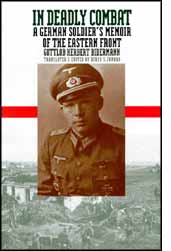 This is a memoir of a young German soldier who started as a landser—infantry man—manning a heavy machine gun and then became a platoon leader. He began his service in the Crimea in a battle group that defeated the Russians and pushed them out of Sevastapool Castle. They were later moved up to join the army besieging Leningrad. They battled the Russian groups trying to break the siege. Later as the Russians pushed the Germans south, out of Russia, they were surrounded and trapped in what was called the Courland pocket. Against overwhelming odds, they resisted all attempts by the Russians to smash their pocket. They held out till the end of the war, when they were finally ordered to surrender. The author was taken prisoner and was one of the few to survive the gulags.
 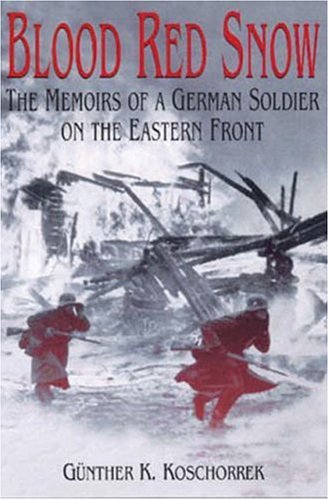 Blood Red Snow is memoir of a German soldier who fought as a heavy machine gunner in Russia, Ukraine and Romania. He also did a short stint in Italy, chasing partisans. This story is very different than A Stranger To Myself. No endless philosophizing or ruminations on the glint of snowflakes against the sun. Instead this is a straight-forward story of what happened to him as an elite front-line soldier.
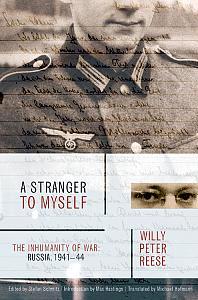 A Stranger to Myself is a book made from the diaries of a young writer/poet/philosopher who died in Russia on his 5th tour on the Eastern Front. This is a memoir about what it was to experience the Eastern Front as a little human not an uber-German. If you've seen any books on the Eastern Front, you've seen the pictures of the winter of '41. The German soldiers in summer uniforms are laying in endless frozen heaps. The walking have their hands and feet wrapped due to frostbite. It is a disaster. Reese entered the war during that winter and lived through the experience in those pictures. He also was on the front near Kursk during the disasterous winter of '43 when Germans were again pushed back. 100'000s German soldiers were killed or froze to death during that winter. He returns to the front in winter '44 as the Germans are getting pushed out of Russia after the failure of Operation Citidel. So this is a memoir of the winter defeats. He misses completely the heady summer of '41 when the Germans pushed to Moscow and the summer of '42 when they pushed to Stalingrad.

 In the second month of the diary, the Russian Army leaves from her part of town. Gone are the Russian visitors. Gone is the food. Back to potatoes and nettles. She joins a number of forced labor call-ups. A day of rubble clearing. A week dismantling a factory and loading it on a train to Russia. I have often wondered how the Germans (esp women) could rebuild Berlin so fast after the war. I had imagined that the women must have been shattered by their experiences. Some were. But this book gives insight into the many women who were not. Who somehow coped and focused on the work to be done and not on self-pity. As one woman comments, "Life goes on..."
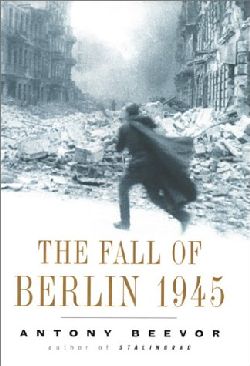 The Fall of Berlin is the follow-up book by the author of Stalingrad: the Final Siege. TFOB starts as the Russians cross the German border in East Prussia. For those who are spotty on their post-WWI geography (meaning 99.999% of us), Prussia was is in the Baltics (meaning up by Lithuania) and extended across modern day northern Germany (formerly East Germany), Western Poland, parts of Lithuania, and far southwestern Russia (parts it annexed after WWII from Germany). Much of the first third of the book is about the invasion of Prussia and the attempts by civilians to escape. This was especially interesting to me because I know someone who's mother and grandmother were among those civilians. About 1/4 million civilians were trapped in Konigsberg at one point, completely surrounded by the Russian Army. My friend's mother was trapped there and was among those that crossed the ice of Frisches Haff (a bay) on foot to reach a small spit of land that the Germans still held. From there they walked into Germany through a thin corridor of German-held land to East Germany. Later after the Germans surrendered, they escaped from East Germany to the West.
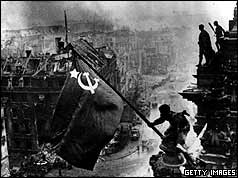 Surprisingly this part of the book was not terribly interesting (for me). Lots of space is devoted to troop movements (yawn). You don't get a sense from the book about what the civilians in Berlin went through. This is surprising since there were many diaries published from that period. For some reason, this part just seemed a bit mechanical. Basically, the sense you get from the book is that Berlin fell without much of a fight in the city proper and then people started getting on with their lives. That's hard for me to believe. The city was reduced to rubble and the depression among the people must have been extreme. My next book is "A Woman in Berlin" which is a diary from the 9 days of the battle. I expect that this book will give a different picture.
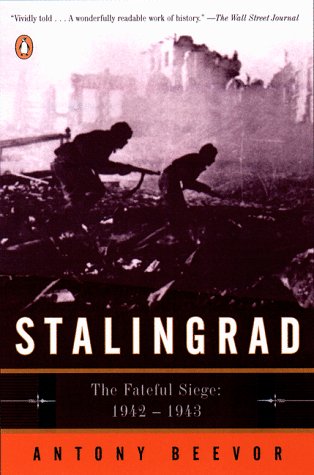 The battle for Stalingrad was the bloodiest battle in the brutal battles on the Eastern front. After surviving a brutal winter and unsuccessful attempt to capture Moscow, the German Army turned its attention to the east and the Caucaus oilfields. They raced forward rapidly in a headlong rush of one success after another. Then they reached the city of Stalingrad on the banks of the Volga. In difficult fighting they managed to capture 95% of the city, but the Russians held on the the north side of the Volga River and a small strip of land on the south side. For months, the Russians and Germans fought a pitiless street battle in the ruins -- while each day winter got closer. In late November 1942, the Russians executed a large counter attack and successfully surrounded the entire 6th Army, by then numbering only about 250,000 men. The Germans were unprepared for winter, and over the next 2 months, they slowly but surely starved to death. When they finally surrendered in early February 1943, they numbered only 90,000. These were taken prisoner and only about 6,000 managed to survive captivity and make it home.
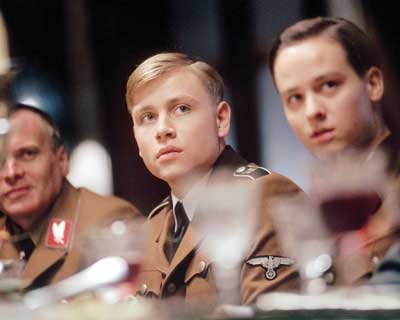 NAPOLA (English name: Before the Fall) is a movie set in the National Political Elite schools of the National Socialists (Nazis) in the 1933-1945 period. At the height, there were about 40 of these schools that aimed to turn young men into the leaders needed for for the worldwide German empire. In many ways, this movie reminded me of Dead Poets Society with no Robin Williams character. Saying that, I've just revealed the entire plot -- yes this movie suffers from predictability. But it is well done and the cinematography is very nice.
 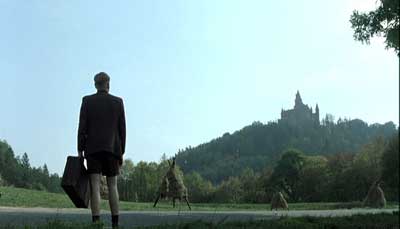 The film semi-effectively shows how otherwise decent young men could get sucked into and worked up by both the Nazi fanaticism and the seduction of a uniform. Although it really has a Hollywood feel to it so this part seems quite real. It also conveys the "island paradise" aspect of these schools. The film is set in 1943, when the war is going badly and people are really suffering from food-rationing, but the boys have enough to eat and have fun adventures like going gliding. A man who who had been in a Napola commented on this very
 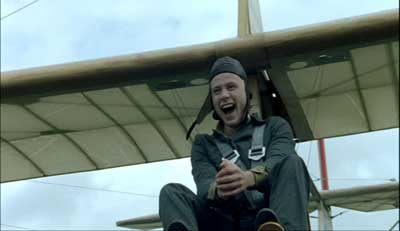 aspect of the schools. This film ends with the note that at the end of the war, the boys in the schools were sent to fight. They fought fanatically and suffered 50% casualties in an utter waste of life.
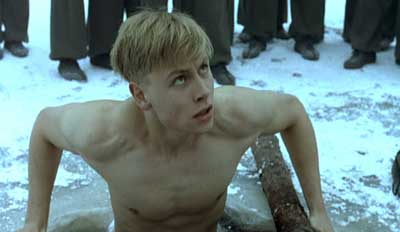 For some very odd reason, Amazon classifies this as a gay film (and apparently whoever made the US DVD cover thought the same thing). However, that's like calling the Dead Poets Society a gay film because it involves young men. Before the Fall involves two young men who are close friends, but they are not friends. However, it's true that the main character is a pretty young man who does spend more time than necessary with his shirt off. Personally, I didn't think this was a bad thing.
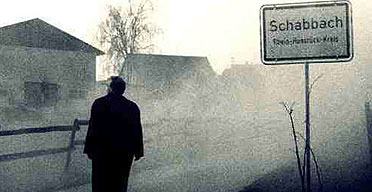 Episode 7 covers the final months of the war. As in previous episodes, it is concerned with the individuals not with what is happening in the country as a whole. It's as if Schabbach is a little enclave, that is affected by the events outside but is much more concerned about it's own little world.
 Episode 4 is set in 1938. This episode focused on Maria and her feeling of not having lived. An engineer is boarding with the family, and Maria falls for him. They awkwardly get to know each other. That's about what happens. The peripherial stuff is more interesting. We see that the Nazi party has heavily infiltrated society. About a third of the men at a social dance are wearing the Nazi armband, including the engineer that is wooing Maria. However, Maria continues to resist sending her boys to the Nazi Jugend. We see signs of the rapid investment in infrastructure by the Nazi's and their popularity on account of that. We see large movements of young men in work crews for the roads. Maria's sister-in-law, married to the Jewish jeweller, is quite well off. He shows off the most popular item, a silver ring with a skull. This is popular among the men on the road crews. As in episode 3, life seems to be changing very rapidly.
