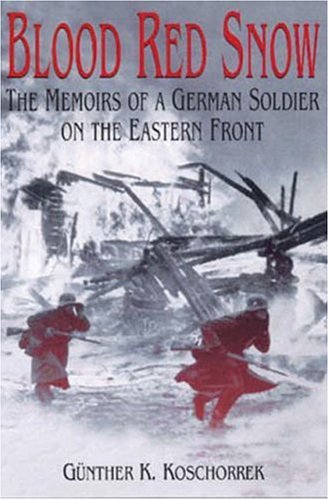
Blood Red Snow is memoir of a German soldier who fought as a heavy machine gunner in Russia, Ukraine and Romania. He also did a short stint in Italy, chasing partisans. This story is very different than A Stranger To Myself. No endless philosophizing or ruminations on the glint of snowflakes against the sun. Instead this is a straight-forward story of what happened to him as an elite front-line soldier.
His first battle is on the outskirts of Stalingrad. He starts as a naive and idealistic young soldier, but that doesn't last long. His first job is a trip into Stalingrad to deliver food at night. This is just before the encirclement, and the battles are done from rubble pile to rubble pile. All he can think about is getting away from the horror. Shortly after the fighting begins and his unit is one of the sacrificial units that are maintaining a fight to the death position. Almost everyone in his unit is killed, and then when all is hopeless the last 10 make a dash to safety through heavy gunfire. They are among those that race across the River Don on foot and are only saved because the ice is too thin for the Russian tanks. It is a brutal fighting retreat. He get injured, gets sent to the rear, and survives.
After a stint in Italy, where not much of interest happens except some looting, he is sent back to Russia. He is now in an elite unit that is steadily retreating from the Russian offensive east into Romania. By this point, he is very weary after so many months of frontline fighting. In the end, he ends up in Poland and is in East Prussia when the Russian arrive. He is once again injured at a lucky time and manages to survive by being in a hospital at the right time.
One interesting section concerns a home-leave he gets in the summer of 1944. He writes that things were very tense at home. Many refugees. People being sent to concentration camps. He does not mention Jews, but rather dissenters and those that refuse to fight. He is not critical of them nor is he sympathetic. Everyone has a duty to do and they refuse to do theirs. In retrospect, we know that Germany mounted an unprovoked attack on Russia in the summer of 1941. But this is not what Germans were told at the time. They were told that Russia was massing troops on the border and this was a defensive attack to protect Germany and Europe from the war-mongering Bolsheviks. I'm sure that this is what everyone believed.
In this memoir, the viewpoint is unconflicted. The Russians are the enemy and they are brutes. He writes about how as his unit retreats and the Russians move forward, the Russians kill villagers in the eastern Ukraine who helped the Germans -- even if they were forced to do so. This is also mentioned in the book, Stalingrad. As they retreat into Romania, he talks about the rampant raping by the Russian soldiers. This is also well documented. He also writes about the treatment of German POWs and that they are killed or worse. Again this well-documented. So to him when he was a soldier, it was clear-cut. He does not mention German war-crimes, but then it sounds like he was not in areas where these were happening in the extreme. He did not fight in the Ukraine in winter 1941 where he would have seen 100,000s of Russian POWs interned with no food nor does he see the round-up of Jews in those areas nor the winter looting and rampant killing of civilians. He does not experience the scotched-earth retreat from Opel. Many other soldiers did experience this and the documentary Mein Kampf has footage taken by these men.
Overall I found this to be an unrealistically rosy picture of German soldiers in Russia. Here there is no mention of the poor treatment of Russian POWs. There is mention of wounded Russians being shot, but this is attributed to sadism. Looting is punishable and soldiers have to be sneaky about it. I don't necessarily doubt that this is a true account of this soldier's experience, and people I've talked to in Czechoslovakia during the war have commented that the German soldiers were well-behaved. Nonetheless, I was struck by the lack of any reference to German treatment of Russian POWs, the massive institutionalized looting, and mass starvation of civilians (like in Leningrad). I cannot believe he was unaware even if he did not personally see this. This especially struck me at the end, where he makes a comment about wanting to be an POW of the Americans since at least they treat POWs according to the Geneva Conventions. I was pretty much flabbergasted by this comment, given what happened to so many Russian POWs. Granted from what I've read, those that were shipped to Germany for slave labor were treated decently, but millions were starved or gassed.
Another part of the book that I read with skepticism was the part where he said he was among the first German troops to come into the village of Nemmersdorf after the Russians briefly took it. Nemmersdorf is the site of the most famous Russian war atrocities in East Prussia. This is the first German town that the Russian troops reached. The Russian troops were accused of killing all civilians, raping the women and girls to death, and then mutilating the bodies. Goebbels had a famous propaganda film made of it. There are questions however about whether it was 'enhanced' for propaganda purposes by SS troops in the area. That the Russians killed the civilians and mass-raped the women and girls meshes with well-documented reports of many, many similar events from East Prussia (discussed in Fall of Berlin). But the Nemmersdorf massacre was also characterized by mutilation and crucifying people on barn doors -- I have never read of anything like that in other reports. In any case, the author claims to have been among those troops that first arrived after the Russians and claims to have seen the mutilated bodies. I found it surprising that of all places, he just so happened to be in Nemmersdorf on Oct 21, 1944.
In the end, I'm not sure what to make of this memoir -- except that it gives me a new insight into more of the evil of war.
Chronology
October-November 1942 On the Don River outside Stalingrad. Makes a hasty retreat and get injured. Thus survives.
October-November 1943 On the Dneiper in Eastern Ukraine some 500km south of Kursk. Russians are in the process of their steady push of the Germans out of Russia. His unit is one of the delaying units set up to give the retreating soldiers more time.
December 1943 Major assault by the Russians on the line of the Dneiper River.
January 1944 Retreat from the Dneiper River near Dneproperovsk.
March 1944 Miserable retreat to just north of the Black Sea. From where they are transferred to Romania.
April 1944 Part of a big successful fight where the Germans defeat the Russians near Lasi (Jassy) on the border between Romania and Moldava. Russian will have it back by July.
June 1944 Heavy fighting near Jassy as Russians are intent on retaking Jassy.
July 1944 Transferred to Poland; hard fighting; losing; injured and off the hospital.
October 1944 Fighting in Poland. Says he is in the troops that first come into Nemmersdorf (the site of a famous Red Army massacre of civilians), but that seems hard to believe.
January-March 1945 In Denmark as a trainer for new recruits.
March 1945 Volunteers for the front with his ragtag group of new recruits. Sent to Stettin on the Oder as the Russians are pushing their way to Berlin. Is soon injured, and sent back to a hospital.
End of April 1945 Is in a hospital that is taken by the Americans, but the Americans turn the German POWs over to Russia. He reinfects his wound to get back to the sick ward, and survives this. Spends time in American camp then released.
Labels: Eastern Front, Germany, memoir, WWII
 Berlin Diary (link to book at Amazon)


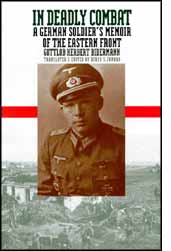 This is a memoir of a young German soldier who started as a landser—infantry man—manning a heavy machine gun and then became a platoon leader. He began his service in the Crimea in a battle group that defeated the Russians and pushed them out of Sevastapool Castle. They were later moved up to join the army besieging Leningrad. They battled the Russian groups trying to break the siege. Later as the Russians pushed the Germans south, out of Russia, they were surrounded and trapped in what was called the Courland pocket. Against overwhelming odds, they resisted all attempts by the Russians to smash their pocket. They held out till the end of the war, when they were finally ordered to surrender. The author was taken prisoner and was one of the few to survive the gulags.
  Tank Rider is a war memoir from a man, Evgyny Bessorov, who served in the Russian infantry during WWII. He was the lowest level of officer, a platoon leader. It was his job to get the soldiers up and rushing at the Germans during the endless battles. He rushed into battle for 2 years carrying usually only a shovel, which he used for its intended purpose (digging in) and to 'tap' the butts of soldiers who had been laying on the ground for too long. He said of his job, no one wants to die, that includes soldiers, it was my job to get them up and running at the enemy. Sometimes he had to physically manhandle his soldiers out of their foxholes; only once did he have to threaten execution. He led his men through 4 or 5 major battles. During each he lost about 80% of his platoon. His survival was pure luck combined with caution.
 From there, it is a relentless 2 year push towards the German border and then into Berlin. He is part of the troops the encircle Berlin from the east. Here he is injured and then rejoins his battalion when they are outside Prague. And then 'Woina kaputt'...the war is finished.
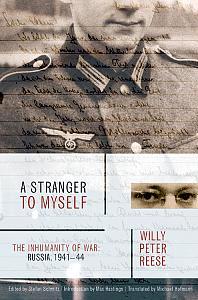 A Stranger to Myself is a book made from the diaries of a young writer/poet/philosopher who died in Russia on his 5th tour on the Eastern Front. This is a memoir about what it was to experience the Eastern Front as a little human not an uber-German. If you've seen any books on the Eastern Front, you've seen the pictures of the winter of '41. The German soldiers in summer uniforms are laying in endless frozen heaps. The walking have their hands and feet wrapped due to frostbite. It is a disaster. Reese entered the war during that winter and lived through the experience in those pictures. He also was on the front near Kursk during the disasterous winter of '43 when Germans were again pushed back. 100'000s German soldiers were killed or froze to death during that winter. He returns to the front in winter '44 as the Germans are getting pushed out of Russia after the failure of Operation Citidel. So this is a memoir of the winter defeats. He misses completely the heady summer of '41 when the Germans pushed to Moscow and the summer of '42 when they pushed to Stalingrad.

 In the second month of the diary, the Russian Army leaves from her part of town. Gone are the Russian visitors. Gone is the food. Back to potatoes and nettles. She joins a number of forced labor call-ups. A day of rubble clearing. A week dismantling a factory and loading it on a train to Russia. I have often wondered how the Germans (esp women) could rebuild Berlin so fast after the war. I had imagined that the women must have been shattered by their experiences. Some were. But this book gives insight into the many women who were not. Who somehow coped and focused on the work to be done and not on self-pity. As one woman comments, "Life goes on..."
