The Red and the White * * *
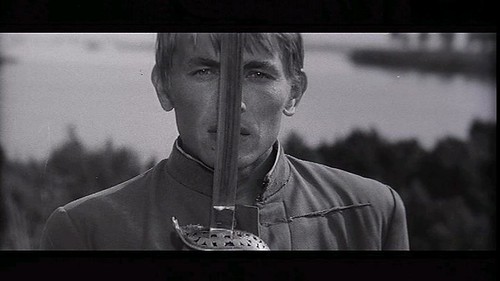 Miklos Jancso's films are famous for plunking the viewer down in the middle of a scene with no background or context to ground the viewer. It's disorienting. The Red and the White is especially like this. As the film starts we see two men running across a field. You don't know who they are and you are never told. What's going on? Who are these characters? Eventually, we piece together that they are fighting for a Red Army militia and being hunted by a White Army militia.
Miklos Jancso films are known for being difficult, oblique, and experimental. We are so ingrained to want to be told a story, to have the comfort of a plot, to know 'what's going on'. But Jancso films are not like that. His is not telling a story – he’s making an impressionist painting. It reminds me of visiting a museum in Europe and staring at one of those huge paintings of a war scene -- except that now the painting is moving. So I think it’s helpful to approach Jancso’s work with the mind-frame of studying a painting, rather than watching a movie.
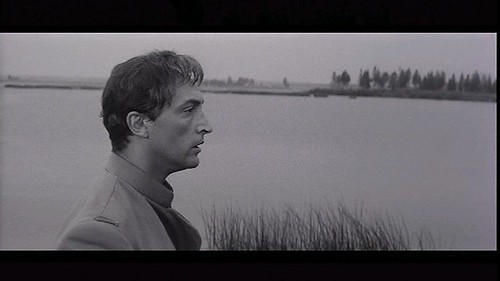 Jancso’s films are purposely disorienting. That said, some basic knowledge of the 1918 Civil War in Russia, will help you feel a little feel disoriented. But I suggest that you view this as an answer to the question 'What is the setting of this painting?' rather than 'What is the setting of the plot?', because this film does not have a plot and there is not meant to be a plot, per se. In the summer of 1918, civil war breaks out in Russia. There is the Red Army which is fighting for the Bolshevik government of Vladimir Lenin and is opposed a variety of anti-Bolshevik forces. One of the more important of these is the White Army, which in the summer of 1918 was a fine fighting force, though small in numbers. There are also a confusing array of other anti-Bolshevik armed groups, such as the Greens. In southern Russia, in the summer of 1918, small bands of these groups are fighting each other. The fighting is characterized by back and forth: capture, retreat, capture, retreat.
Enjoying Miklos Jancso's films is greatly enhanced by doing some research on what your watching beforehand. Otherwise, you’re likely to respond "What the &*#!3 is this piece of $#%?". Here are some of the important themes:
* Unique use of the screen
* Use of landscape as the stage
* Purposely, disconnecting the viewer from the action. You are an observer. You see but are not explained. The actions of the 'characters' are inexplicable. I put characters in quotes, because there are not characters in the traditional sense of the word, in many of Jancso's films.
* Ritual
* Long, long takes. One of his films uses only 6 takes.
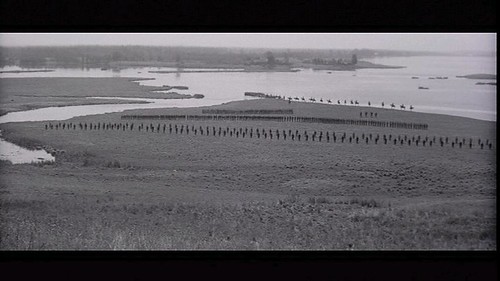 The Red and the White is ranked by film critics as one of Jancso's best pieces of work and an important anti-war film. But for me personnally, I liked Electra, My Love better. Electra, My Love is much more 'over the top'. The surreal aspects are presented with a sledge hammer, and the wide open plains are used as a dance stage. I could appreciate Jancso's unique style without trying to figure out what was going. In Red and the White, I was continually distracted by trying to figure who was White and who was Red. However other people really like this movie: RandW review.
My take: You have to be interested in world directors or experimental film to enjoy this film. Be ready for 'something completely different', because nobody makes films that look quite like Miklos Jancso's.
Rented from Scarecrow Video.
My epinions review of The Red and the White.
posted by eeh at 2:43 PM



